
How to Check for a McIntosh County Warrant
There is no single button to press here. McIntosh County does not run a public website that lists active warrants. So the smart move is to start with the office that holds them. The McIntosh County Sheriff serves warrants and processes papers ordered by the District Court. A call to the Sheriff's Office is the fastest way to ask whether a warrant exists for a named person. During business hours the main line is 918-689-4357. After hours, county dispatch answers at 918-689-2526. You can also go in person to the Sheriff's Office at 1425 Industrial Dr in Eufaula.
The second route runs through the court. Most McIntosh County warrants are tied to a District Court case, and that case is searchable. The Court Clerk keeps the file, and the public docket may show a warrant or a warrant event when the case is not sealed. You can search the case yourself on ODCR at www1.odcr.com or on the Oklahoma State Courts Network at oscn.net, or call the Court Clerk at 918-689-2282. A paid ODCR tool adds an outstanding warrant filter for about five dollars a month.
City tickets are different. A missed municipal court date can trigger a bench warrant that stays with the city, not the county. Once an arrest happens, state systems take over for custody status. The table maps each McIntosh County warrant channel, the fields it accepts, and what it can show.
| Portal | Fields | Required | Notes |
|---|---|---|---|
| Official sheriff warrant search | None located | n/a | No official public warrant portal was found for McIntosh County; call or visit the Sheriff's Office instead |
| ODCR standard search | Court, party name, case type, case number, filed or activity date | Depends on the search | Public dockets may show warrants or warrant events when the case is not sealed |
| ODCR advanced tools | Outstanding warrant filter | Paid advanced tool | Advertised at about $5 per month |
Note: No McIntosh County agency publishes a live online warrant list, so a phone call to the Sheriff or the Court Clerk is the surest way to confirm a warrant.
Types of Warrants in McIntosh County
Not all McIntosh County warrants work the same way. A judge signs some on the spot in court. Police seek others from the bench before an arrest. Knowing the type helps you guess which office holds it and how to clear it. These are the main kinds you may run into.
- Arrest warrant - issued when there is probable cause to believe a person committed a crime, often after the District Attorney files a charge.
- Bench warrant or failure to appear - signed by a judge when someone misses a court date or ignores a court order.
- Search warrant - authorizes police to search a place or seize items; ODCR lists Search Warrants as its own case type, and some stay sealed until served.
- Probation warrant - issued when a person on supervision is accused of breaking the terms of probation.
- Protective-order violation warrant - follows an alleged breach of a victim protective order filed with the Court Clerk.
- Fugitive or out-of-county hold - lets the county hold a person wanted by another court or state.
- Municipal bench warrant - tied to a city citation or ordinance case, and held by the city court rather than the District Court.
Note: A sealed search warrant or a sealed indictment may not appear in any public McIntosh County search until it is unsealed or served on the named person.
Contacting the McIntosh County Sheriff About Warrants
The Sheriff's Office is the front door for warrant questions. Sheriff Kevin Ledbetter leads the office, which serves District Court warrants, runs the county jail, and has the power to arrest people charged with a felony or a breach of the peace. Staff can tell you whether a warrant is on file, though they will not always share sensitive detail over the phone. The office sits on Industrial Drive, away from the downtown courthouse.
McIntosh County Sheriff's Office
1425 Industrial Dr
Eufaula, OK 74432
918-689-4357
After hours / dispatch: 918-689-2526
Mon-Fri 8:00 a.m. to 4:00 p.m.
Call the main line first during the day. Use the dispatch number after hours, on weekends, or when you need to confirm whether someone has just been taken into custody. If you plan to come in person, the office keeps the same weekday hours as most county offices.
Finding Warrants in McIntosh County Court Cases
Most warrants grow out of a court case, so the case file is a strong second source. Oklahoma runs two free docket systems. On Demand Court Records, known as ODCR, sits at www1.odcr.com and includes McIntosh County District Court under the court value 046-. The Oklahoma State Courts Network, or OSCN, at oscn.net is the judiciary's own site and also lists the county. Search either one by party name in Last, First order or by a full case number.
Warrant clues hide in the docket text. A criminal or traffic case may log a warrant issue date, a failure-to-appear note, or a later recall entry. Case-number prefixes help you spot the kind of case at a glance. CF marks a felony, CM a misdemeanor, TR a traffic ticket, and PO a protective order. The full criminal file, with the charges and the outcome behind a warrant, lives in the McIntosh County criminal court records.
Sealed cases are the exception. A sealed search warrant or a sealed indictment may not appear at all until it is unsealed or served. When the docket looks incomplete, the official Court Clerk file controls, so call 918-689-2282 to confirm a detail before you act on it.
McIntosh County Bench Warrants and City Courts
A municipal warrant can surprise people who only check the county. Cities in McIntosh County run their own municipal courts for ordinance violations and city traffic tickets. When someone skips a city court date or fails to pay a city fine, the municipal judge can issue a bench warrant. That order usually stays with the city, and it will not show up in a District Court search on ODCR or OSCN.
The citation itself is the clue. Look at the court named on the ticket. If it points to a city court rather than the District Court, contact that city's court clerk directly. Clearing a municipal bench warrant often means paying the fine, setting a new court date, or appearing before the city judge.
What a McIntosh County Warrant Record Shows
Because there is no public warrant portal, the detail you can see usually comes from the court docket. McIntosh County did not publish a sample warrant listing, so the fields below reflect what a public criminal or traffic docket commonly shows when a warrant is not sealed. The amount of detail varies from case to case.
| Field | What It Shows |
|---|---|
| Case Number | The District Court case the warrant is attached to, built from a prefix, year, and sequence |
| Party or Defendant | The named person the warrant is issued against |
| Warrant Issue Date | The date the court or judge ordered the warrant |
| Warrant Type or Event Text | The docket label, such as bench warrant, failure to appear, or arrest warrant |
| Bond Amount | The release amount set with the warrant, when one is entered |
| Issuing Judge or Court | The District Court judge or court division that signed the order |
| Charge or Case Type | The offense or case category behind the warrant |
| Recall or Return Entry | A later note showing the warrant was served, quashed, or recalled |
Treat these fields as a guide, not a promise. A sealed matter may hide most of them. When a record looks wrong or thin, the Court Clerk holds the file that controls.
How to Resolve a McIntosh County Warrant
An open warrant does not go away on its own. It can lead to an arrest at a traffic stop, at work, or at home. The better path is to handle it on your own terms. The steps below outline how most people clear a McIntosh County warrant, though the right order depends on the case and on legal advice.
- Confirm the warrant first. Call the Sheriff's Office at 918-689-4357, or search the District Court case on ODCR or OSCN, so you know the case number and the type.
- Talk to a lawyer. Private counsel or the local Oklahoma Indigent Defense System contractor can explain your options before you act.
- Contact the court or sheriff for instructions. Ask how the office wants you to appear and whether a bond can be posted.
- Appear or surrender as directed. Show up to the hearing, or arrange a voluntary surrender, rather than waiting to be picked up.
- Post bond or resolve the underlying issue. Pay or schedule fines and costs when you are eligible, or ask the court for a hearing.
- Get proof. Obtain a copy of the order that recalls, quashes, or dismisses the warrant, since clearance is not instant across every system.
Important: Talk with an attorney before you turn yourself in, because the timing, the bond, and the plea all affect the outcome of the case.
Checking Custody Status After an Arrest
Once a warrant is served, the question shifts from "is there a warrant" to "where is the person now." McIntosh County does not post a public online jail roster, so custody status comes through official channels. Call the Sheriff's Office during the day or county dispatch after hours to ask whether a person is in the county jail. Oklahoma VINE adds automated custody notifications statewide at vinelink.vineapps.com.
State prison is a separate track. After sentencing or transfer, a person may move into the custody of the Oklahoma Department of Corrections, searchable at okoffender.doc.ok.gov. That lookup covers sentenced state inmates, not county pretrial holds. For the booking side and the full set of jail contact channels, see the McIntosh County inmate records.
Note: VINE and the DOC lookup are statewide tools, so they may not reflect a brand-new McIntosh County booking until the county or state system updates.
Protecting McIntosh County Records From Fraud
Warrants are not the only filing that can affect a person without warning. Property records can be targeted by fraudulent deeds and liens, and the county offers a free way to watch for them. The McIntosh County Clerk runs a free land-record monitoring tool that alerts a subscriber when a document is recorded against their name.
This service is a land-record fraud alert, not a warrant search. It will not tell you whether you have an active warrant. It is listed here as a useful related county service for anyone who wants to guard their property filings while they handle other county business.
Federal Warrants Tied to McIntosh County
Some serious cases tied to McIntosh County never reach the District Court at all. The county sits in the U.S. District Court for the Eastern District of Oklahoma, and that court sits in Muskogee rather than Eufaula. Federal warrants, federal charges, and many Indian Country cases after the McGirt decision run through that federal system and through the U.S. Marshals Service, not the county sheriff. You can review the court's Muskogee Eastern District location page for the federal building and contact detail.
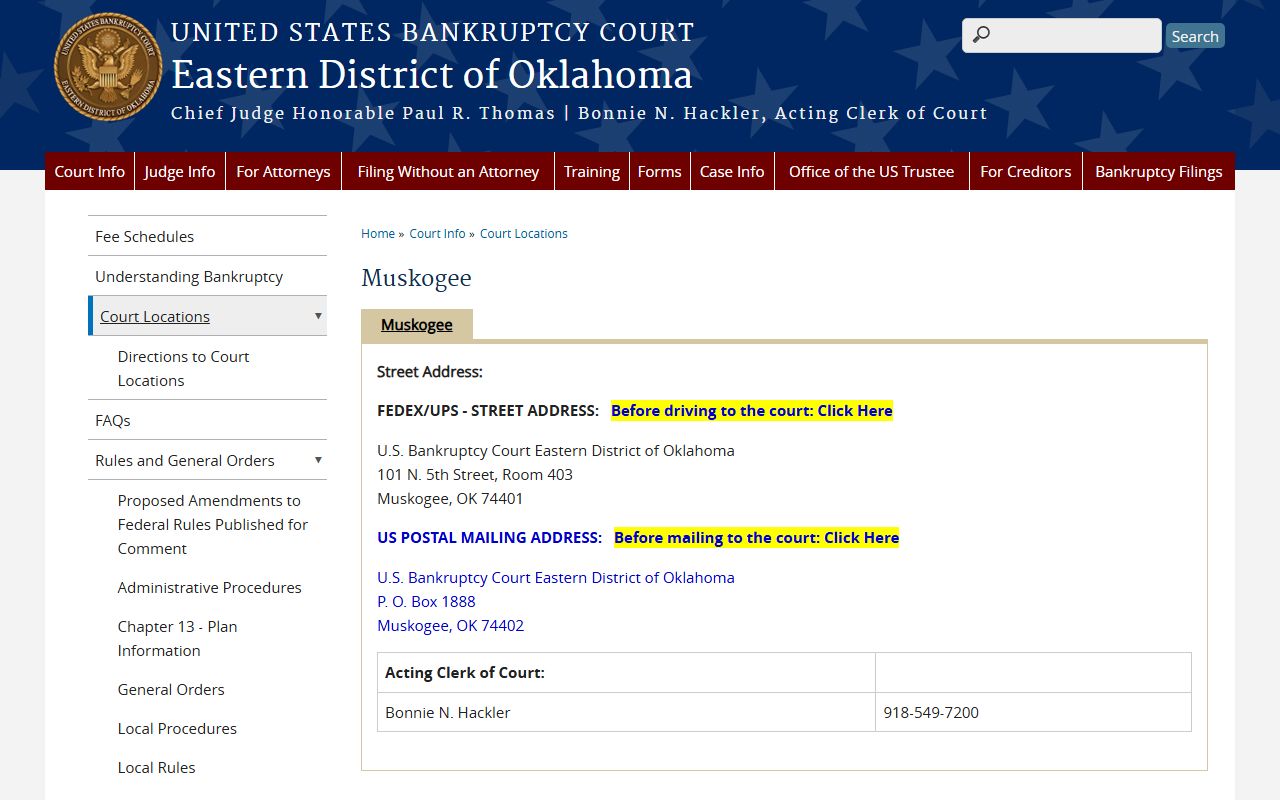
Federal records are not searched on ODCR or OSCN. They live in the federal PACER and CM/ECF systems. When a McIntosh County resident is named in a federal matter, the warrant and the case file sit with the federal court in Muskogee, so that is where to direct the question.
Note: Tribal citizenship and reservation location can route a McIntosh County case to federal or tribal court, which changes where the warrant and the file are held.
Clearing McIntosh County Warrant Records
Resolving a warrant ends the active order, but the case behind it can linger in public search. Oklahoma allows eligible people to seal an arrest or court record through expungement. The categories and the steps sit in 22 O.S. 18 and 22 O.S. 19. Eligibility turns on the outcome and the timing, such as a dismissal, an acquittal, a completed deferred sentence, or certain nonviolent convictions after a waiting period.
The process starts with a petition filed in the McIntosh County District Court. The petitioner gives notice to the agencies that hold the record, pays filing and service costs unless waived, and appears for a hearing when the judge orders one. A granted order tells the courts, law enforcement, and the OSBI to seal public access. Sealing does not destroy every government copy, and some agencies keep a restricted version for authorized use.