
Criminal Court Records in McIntosh County
A criminal court record is the case file the court starts when the state files a charge. In McIntosh County, the Court Clerk records, files, and keeps the permanent records of the District Court. That duty covers the criminal division along with civil, probate, and family cases. Once a charge is filed, the clerk opens a numbered case and logs every step that follows. The file grows as the case moves. It holds the charges, the dates, the court events, and the final outcome. Court Clerk Lisa Rodebush leads that office, and her staff manage these records day to day.
Almost all criminal cases in the county run through the McIntosh County District Court. The District Court is Oklahoma's main trial court, and it sits at the courthouse in Eufaula. Felony cases carry the CF prefix on the docket. Misdemeanor cases carry CM. A felony is the more serious class and can bring prison time. A misdemeanor is a lesser crime with lighter penalties. City ordinance cases may run through a municipal court instead, so those may not show in the District Court file. The full case file and outcome live in these criminal records, while a closer look at the counts sits with the McIntosh County arrest records and charges.
How to Search McIntosh County Criminal Court Records
Two free portals carry McIntosh County District Court cases online. On Demand Court Records, known as ODCR, is the most direct path for this county. It shows a full public search form with the county already in its court list. The Oklahoma State Courts Network, or OSCN, is the statewide judiciary search and lists McIntosh County as well. Both let you look up a case by name or by case number at no cost.
- Open the ODCR search page and choose McIntosh County from the court list.
- Search by the defendant's last name and first name, or enter the full case number.
- Narrow the results by case type, such as criminal felony or criminal misdemeanor, and by filed date.
- Open the case to read the docket, the charges, and the disposition.
- Ask the Court Clerk for a certified copy when you need an official version for court or other formal use.
Free ODCR search covers party-name lookups, case-number lookups, and filed-date ranges. A paid advanced tier adds tools like a date-of-birth filter and an outstanding warrant filter. OSCN works as a second route when a case does not load on the first try. For a statewide criminal history rather than a single case, the search shifts to other agencies. State-sentenced custody is tracked by the Oklahoma Department of Corrections, not by the court docket.
Stages of a Criminal Case
A criminal case moves through set stages, and each one leaves a mark in the record. The path starts when the District Attorney files the charge after a law-enforcement referral. From there the case runs through arraignment, pretrial work, a plea or trial, and then sentencing if there is a finding of guilt. The docket logs each step with a date and a short entry. Reading those entries in order shows exactly where a case stands.
Case flow: Charges Filed › Arraignment › Pretrial / Motions › Plea or Trial › Disposition › Sentencing
| Stage | What Happens |
|---|---|
| Arraignment | The defendant first appears, hears the charges, and enters a plea of guilty, not guilty, or no contest. |
| Pretrial / Motions | Lawyers exchange evidence, file motions, and argue legal issues before any trial date is set. |
| Plea or Trial | Most cases end in a negotiated plea; the rest go to a judge or jury for a verdict. |
| Sentencing | After a guilty plea or verdict, the judge sets the penalty, which may include jail, fines, or probation. |
Note: A docket entry is a dated log line, so reading the entries from top to bottom tracks a McIntosh County criminal case from its filing to its final order.
Reading Dispositions and Sentences
A disposition is the outcome the court records for a count. Common entries are short. Guilty means a conviction was entered. Not guilty means an acquittal. Dismissed means the count was dropped before any finding. A nolo, or no contest, plea accepts the penalty without admitting guilt. A deferred result holds the case open under conditions, and it may be dismissed later if the terms are met.
- Guilty
- A conviction, entered by plea or by verdict.
- Deferred
- A finding held open under set conditions before a conviction is entered or the case is dismissed.
- Probation
- Supervised release on conditions, used in place of or after time in custody.
- Suspended sentence
- A penalty set but not served as long as the person follows the court's terms.
The sentence follows a conviction. It can mix custody, fines, court costs, and probation. The record lists each part and tracks whether fines and costs are paid. A payment plan reference may appear when costs are spread out over time.
What a McIntosh County Criminal Court Record Shows
The case file is built from many fields, and each one answers a basic question about the case. The header names the court, the case number, and the parties. The body logs the charges, the events, and the money owed. The closing entries show how the case ended. Oklahoma case numbers follow a simple pattern of case type, year, and a sequential number, such as CF-2020-1. Once you know the fields, a long docket reads quickly.
| Field | What It Shows |
|---|---|
| Case Number | The court's unique ID, built from a type prefix, the year, and a sequential number. |
| Defendant | The person charged, listed by name with any aliases the court entered. |
| Charges | Each count, with the offense name, the statute cited, and its class. |
| Plea | The defendant's answer to each count, such as guilty, not guilty, or no contest. |
| Disposition | The current or final outcome of each count in the case. |
| Sentence | The penalty set after a conviction, such as time, fines, or probation. |
The District Attorney's Role in McIntosh County
Criminal charges are filed by the District Attorney, not by the police. After an arrest, law enforcement refers the case to the DA, who reviews it and decides what charges to file. District 25 covers McIntosh and Okmulgee Counties. Carol Iski serves as the District Attorney for the district. Assistant District Attorneys Sara Dupree and Gregory R. Stidham help prosecute the county's cases.
The DA's office handles felony and misdemeanor prosecutions through the District Court. It appears at hearings, negotiates pleas, and may offer diversion or supervision in some cases. The charging decision shapes the whole file, since the counts the DA files set what the court will weigh.
Charges vs. Convictions
Being charged is not the same as being convicted. A charge is only an accusation, filed when a prosecutor finds probable cause. A conviction comes later, and only if the state proves the case beyond a reasonable doubt or the defendant pleads guilty. A McIntosh County criminal court record can show charges that were dropped, dismissed, or that ended in an acquittal. Reading the disposition for each count, not just the charge, is the only way to know the real result.
| Charge | Conviction | |
|---|---|---|
| Stage | Accusation | Verdict or plea |
| Burden of Proof | Probable cause | Beyond reasonable doubt |
| Public Record | Yes | Yes |
Bond and Warrants in McIntosh County Cases
Bond and warrants both show up in the criminal file. After an arrest, the court may set a bond, which is the condition for release while a case is pending. A bond can be cash, a surety backed by a bondsman, or a release on other terms. The amount and type appear on the docket. If a defendant misses a required court date, the judge can issue a bench warrant.
- Arrest warrant, issued on probable cause to take a person into custody.
- Bench warrant, issued by a judge, often for a missed court date.
- Search warrant, which authorizes a search rather than an arrest.
- Probation warrant, tied to an alleged violation of release terms.
The McIntosh County Sheriff serves warrants and process ordered by the District Court. Sheriff Kevin Ledbetter's office handles that work from its building on Industrial Drive in Eufaula. Active warrants may not all appear in a free docket, and some search warrants stay sealed until they are served.
Sealed vs. Expunged Records
Some criminal records can be sealed or expunged so they leave public view. In Oklahoma, an eligible person files an expungement petition in the District Court under the state's expungement statutes. Eligibility turns on the outcome and the wait time. An acquittal, a dismissal, a reversed conviction, a completed deferred sentence, or certain older nonviolent convictions can qualify. The petitioner gives notice to the prosecutor and the agencies that hold the record, then appears at a hearing if one is set. If the judge grants the order, courts and law enforcement seal or update public access.
| Sealed | Expunged | |
|---|---|---|
| Visibility | Hidden from public | Treated as never existed |
| Law Enforcement | Limited access | Very limited access |
| Eligibility | Set by court order under 22 O.S. 18 categories | Granted under 22 O.S. 18 and 19 for listed outcomes |
Note: An expungement does not always destroy every government file, since some agencies may keep a sealed record for authorized court or law-enforcement use.
Public Access to Criminal Court Records
Oklahoma treats court records as open by default. The Open Records Act makes the files of public bodies available for inspection and copying during business hours. Court case records fall under that rule unless another law makes a specific file confidential. The online dockets are a convenience copy. The clerk's official case file controls if the two ever differ, a point the Court of Criminal Appeals states in its own rule.
Key Statutes:
51 O.S. § 24A.5 - Records of public bodies are open for inspection and copying, subject to listed confidentiality exceptions.
51 O.S. § 24A.8 - Law-enforcement agencies must make certain arrest and incident information available to the public.
OCCA Rule 2.6 - The online case search is a public convenience; the court's case-management record is the official source.
Public Defense in McIntosh County
People who cannot afford a lawyer have a right to court-appointed counsel. In McIntosh County, that defense is provided through the Oklahoma Indigent Defense System, known as OIDS. OIDS contracts with local attorneys to handle non-capital trial work in the county. Cindy Dawson is the listed McIntosh County contractor, based in Eufaula.
The OIDS county coverage page names the McIntosh County contractor and the system's non-capital trial contacts. You can review it on the Oklahoma Indigent Defense System McIntosh County coverage page.
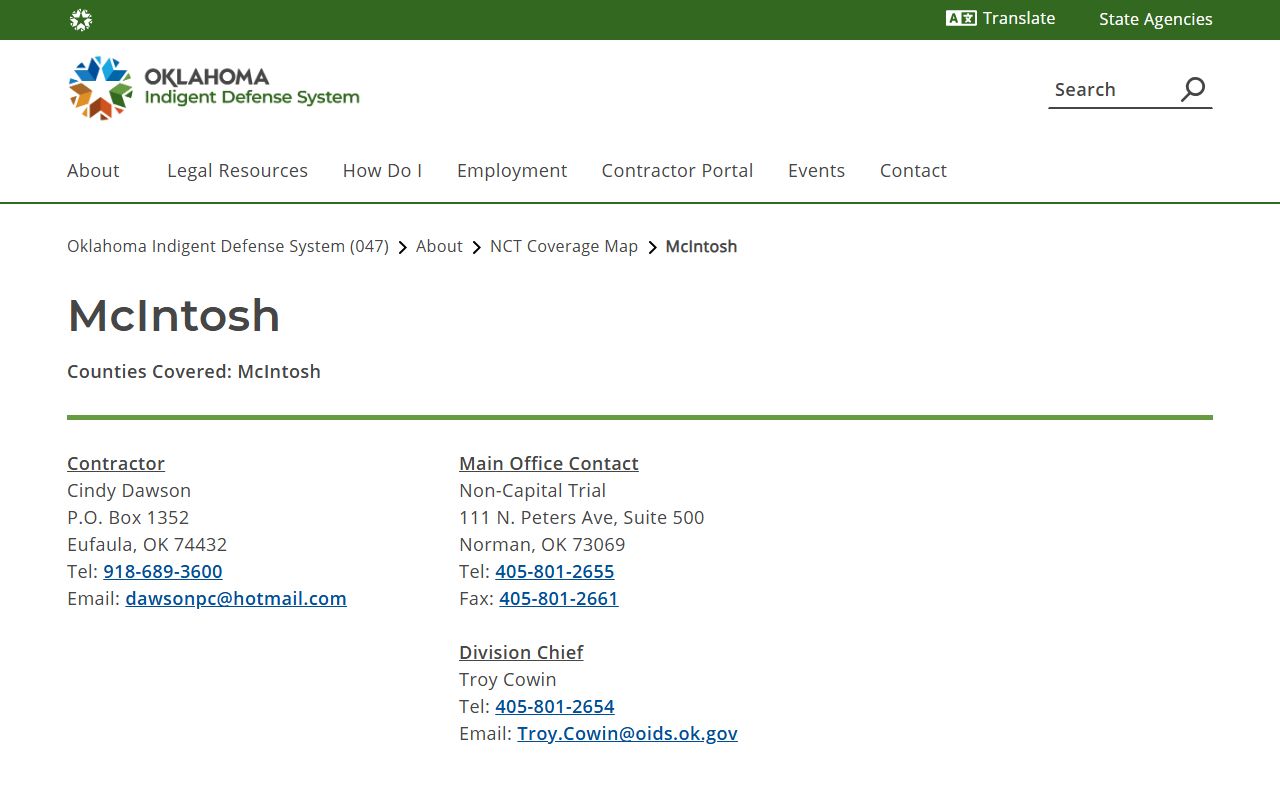
The page lists the contractor's contact details and the OIDS office that backs local appointed cases. OIDS works to give indigent defendants representation on par with what a paying client would get, and to do it at a reasonable cost. A defense lawyer reviews the charges, tests the state's evidence, and speaks for the defendant at each stage. The appointment shows in the case file once it is entered.
The agency's main site explains its mission and statewide role, posted on the Oklahoma Indigent Defense System homepage.
That statewide structure is why a local McIntosh County case may list an OIDS attorney rather than a private one. The defense entry becomes part of the public docket along with the charges and the court dates.
Federal and Tribal Criminal Cases
Not every serious crime tied to McIntosh County is a state case. The county sits within the Eastern District of Oklahoma for federal court, and the federal courthouse is in Muskogee. Federal cases cover federal crimes, civil rights matters, and certain Indian Country crimes. After the Supreme Court's McGirt decision, jurisdiction can shift when the defendant is a tribal member and the crime occurred within reservation boundaries.
Much of McIntosh County lies within the Muscogee (Creek) Nation reservation. In some cases, a charge that once ran through the District Court now belongs in federal or tribal court instead. One vacated McIntosh County murder conviction was retried in federal court for that reason. Federal cases are searched through PACER, not ODCR, and the U.S. Attorney for the Eastern District handles federal prosecutions.
The U.S. Attorney's Office for the Eastern District of Oklahoma publishes its contact details and case news on its official site.
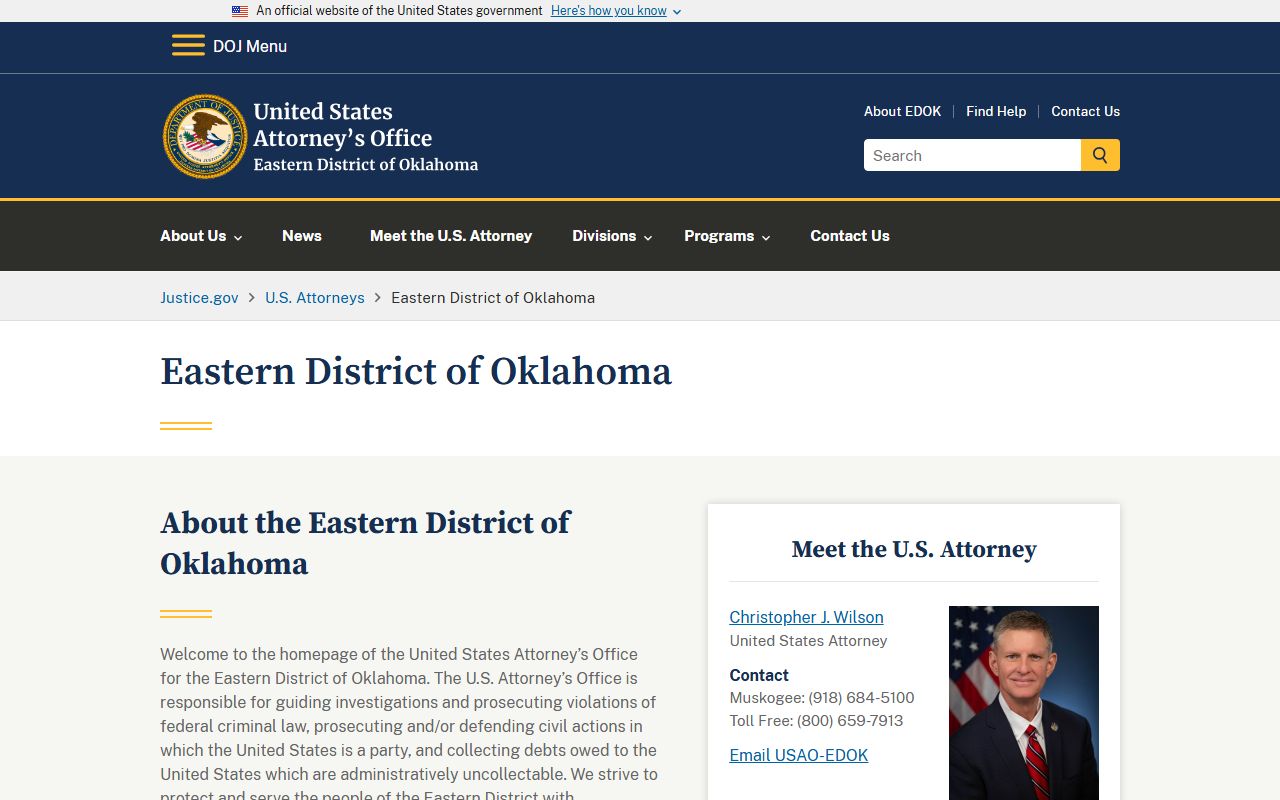
Checking that office helps when a McIntosh County case appears to have moved out of state court. Note: Jurisdiction in some McIntosh County criminal cases depends on tribal citizenship and where the crime occurred, so a case may be state, tribal, or federal.
Background Check Considerations
People look up criminal records for many reasons. A landlord, an employer, or a volunteer group may want to check a name. There is a key limit. A casual docket search is not a background check under federal law. The Fair Credit Reporting Act, or FCRA, governs reports used for hiring, housing, credit, or insurance. Those reports must come from a regulated consumer reporting agency that follows strict accuracy and notice rules. Free court dockets do not meet that bar, and they may miss sealed or updated entries.
Important: This site is not a consumer reporting agency under the FCRA, and its records may not be used for employment, housing, credit, insurance, or other FCRA-covered decisions.
Restricted Criminal Court Records in McIntosh County
Some criminal court records are closed or limited. Juvenile cases are confidential under Oklahoma law, so public results may be limited or absent. Sealed and expunged cases drop out of the public docket. Personal identifiers like Social Security numbers and financial account data are redacted. Sealed search warrants and pending matters may not show until they are unsealed or served. For records that do not appear online, the Court Clerk can confirm what exists and what may be released. These criminal files are one slice of the county's broader court records, which also include civil, family, and probate cases.