
Probate in the McIntosh County District Court
Oklahoma does not run a stand-alone probate court. Probate is a division of the District Court, and every county works it the same way. In McIntosh County, a probate case is filed in District Court and the Court Clerk keeps the permanent record. There is no separate probate courthouse to visit. The same office that holds civil, criminal, and family files also holds the estate files.
The District Court sits in the courthouse in downtown Eufaula. A judge of that court hears the estate, signs the orders, and admits the will when one exists. Because probate is a court proceeding, the steps follow Oklahoma statute rather than a county form. The clerk's job is to file, index, and preserve each paper as the case moves.
That structure matters for a search. You look for a McIntosh County probate record the same way you look for any District Court case, not through a special probate registry.
What McIntosh County Probate Records Cover
Probate is broader than wills alone. The division handles the legal transfer of property after a death and the legal care of people who cannot manage their own affairs. ODCR groups these matters into a set of case types that all live in the District Court.
- Decedent estates, both with a will and without one.
- Wills filed for safekeeping or admitted to probate.
- Guardianships over a minor or an incapacitated adult.
- Conservatorships over a protected person's finances.
- Trust proceedings tied to the administration of a trust.
- Miscellaneous probate matters that do not fit a standard estate.
Each of these opens a case in McIntosh County District Court and produces a file the Court Clerk maintains. A guardianship or conservatorship can carry sensitive material, so part of that file may sit outside public view.
Probate Terms Defined
Probate filings use words that rarely come up anywhere else. A short glossary helps when you read a McIntosh County estate file or talk with the Court Clerk.
- Testator
- The person who made the will. The will speaks for the testator after death.
- Executor
- The person named in a will to carry it out. Oklahoma also calls this role the personal representative.
- Intestate
- Dying without a valid will. The estate then passes under Oklahoma's intestate succession rules.
- Guardianship
- A court arrangement that puts one person in charge of the care of a minor or an incapacitated adult.
- Conservatorship
- A court arrangement that puts one person in charge of a protected person's money and property.
These terms show up across the orders, letters, and notices that fill an estate file.
How to Search McIntosh County Probate Records
The fastest path online is On Demand Court Records, known as ODCR, which McIntosh County links for District Court searches. The basic docket search is free. You can look by a party name or, if you have it, by a full case number. Probate files use the PB and PR prefixes.
- Open ODCR and select McIntosh as the court.
- Enter a party name in the Last, First format, or a full case number if you have one.
- Set the case type to a probate category such as Probate Proceedings, Probate Miscellaneous, Guardianships, Conservatorship, Trust Proceedings, or Filing of Wills.
- Run the search and open the matching docket to read the case events.
- If the file is old, sealed, or missing scanned images, call or visit the Court Clerk for the paper record.
The portal returns a notice when too little information is entered, so add a name or a date range if the first search comes up empty. You can reach ODCR through the county Court Clerk page at mcintosh.okcounties.org, which also links the statewide OSCN docket system.
Note: ODCR's free search shows the docket, while scanned probate documents and an outstanding-warrant filter sit behind paid advanced tools and a bar-member image subscription.
McIntosh County Probate Records Contact
The Court Clerk is the office to call for any probate file. It records, files, and keeps the permanent records of the District Court, which includes the probate division. A request for a copy, a certified copy, or help finding an older estate goes to this office, not to a separate probate clerk.
McIntosh County Court Clerk
Lisa Rodebush
110 N First St
Eufaula, OK 74432
918-689-2282
Mon-Fri 8:00 a.m. to 4:00 p.m.
The mailing address for the office is PO Box 426, Eufaula, OK 74432. For a quick check on an estate, the phone line is the easiest start, and staff can tell you whether the file is open to the public or partly restricted.
What a McIntosh County Probate File Contains
An estate file builds up over the life of the case. It opens with a petition and grows as the court signs orders and the representative reports back. The exact mix depends on whether there is a will, a guardianship, or a trust, but the core parts repeat across most files.
- The application or petition that opens the case.
- The decedent or protected person's name and the named heirs or devisees.
- The personal representative, guardian, or conservator, plus the attorney and the judge.
- The filing date, the published notices, and the orders admitting a will or making an appointment.
- Letters testamentary, letters of administration, or letters of guardianship.
- The inventory and appraisement, creditor notices and claims, and any sale petitions.
- Accountings and the final decree or discharge that closes the case.
A docket entry shows when each step happened. To read the full document behind an entry, you may need the scanned image online or a copy from the Court Clerk.
Filing Fees for McIntosh County Probate Records
McIntosh County publishes a fee page, but it covers County Clerk recording and open-records charges, not Court Clerk probate filing or copy fees. For the cost to open a probate case or pull a certified copy of an estate order, confirm the current amount with the Court Clerk before you file. Probate and estate administration run under Oklahoma's statutory framework in 58 O.S., which sets the proceedings rather than a flat county price.
The fees below come from the County Clerk recording schedule. They apply when a probate-related deed, decree, or affidavit is recorded in the land records, which is a separate step from the court case.
| Item | Amount |
|---|---|
| Probate filing or copy fee (court case) | Confirm with the Court Clerk |
| Recorded document, first page (County Clerk) | $8 |
| Additional recorded page (County Clerk) | $2 |
| Copy fee per page (County Clerk) | $1 |
| Certification per document (County Clerk) | $1 |
Note: The county fee page lists County Clerk recording charges, so any cost tied to opening a McIntosh County probate case must be confirmed with the Court Clerk.
Cross-Checking McIntosh County Land Records
Probate often touches real estate. When a court admits a will or signs a decree that moves land, that paper frequently lands in the County Clerk's land records as well. The County Clerk is a separate office from the Court Clerk, and it handles deeds, plats, liens, and recorded decrees. A full picture of an estate that held property may need both files.
You can search the recorded land records for McIntosh County on the county land-records search page.
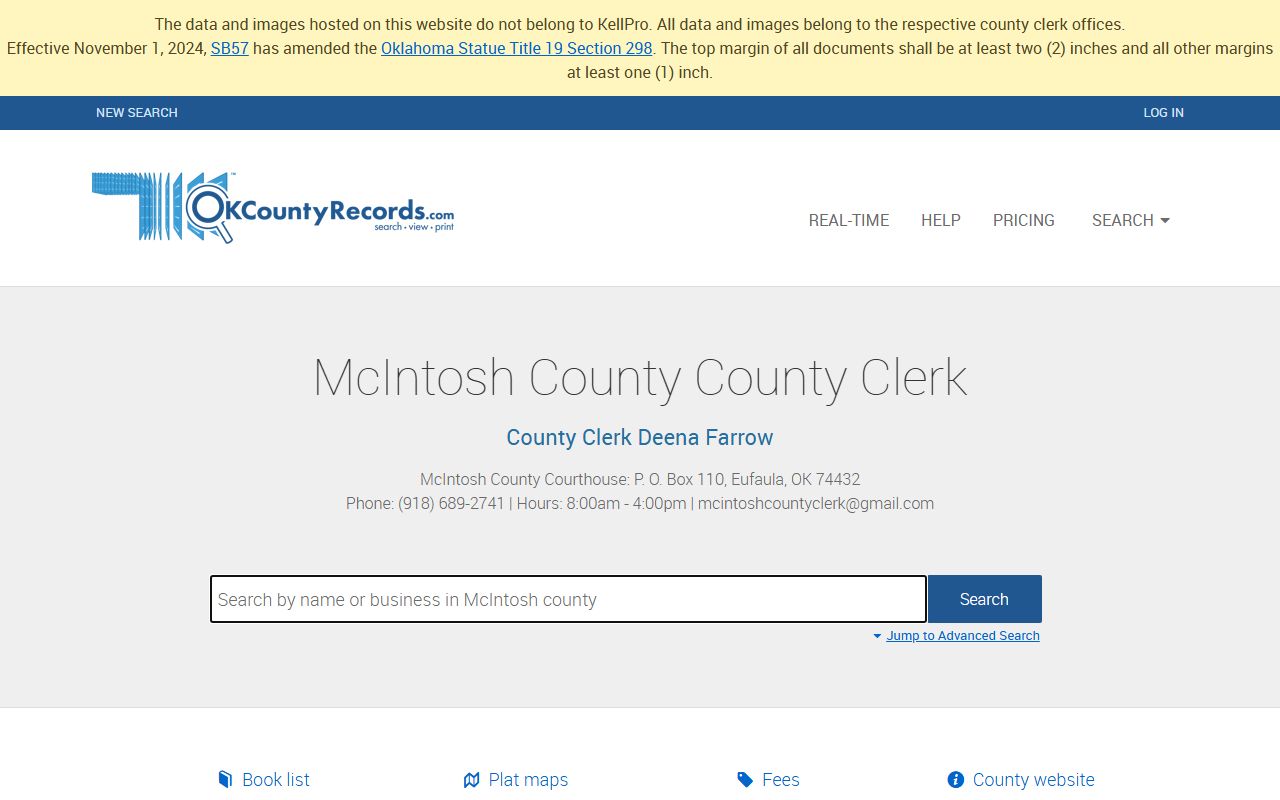
The land-records site indexes recorded documents and carries scanned images for a coverage range. So if a probate decree transferred a house or mineral interest, the recorded version can show up here even when the court docket lives on ODCR. The two systems serve different purposes, and a careful search uses each.
Older McIntosh County Probate Records and the 1925 Fire
Old estate files can have holes. The old courthouse burned in July 1925, and many county records were lost in the fire. The current courthouse was built in 1927. Because of that loss, a probate, land, or marriage record from before 1925 may be incomplete locally, and the surviving set is uneven.
The County Clerk still holds some material that predates the fire, but a researcher chasing a pre-fire estate should expect gaps. When the local file is missing, alternate sources help. Archived indexes, docket references in later cases, and Oklahoma Historical Society collections can fill in part of the story.
The county has leaned hard into preservation since then. Original record books that are now digitized have been moved to underground salt-mine storage in Kansas, kept cool, dry, and stable far below ground.
Oklahoma Probate Statutes
Probate in McIntosh County follows state law, not a local ordinance. The estate process, the appointment of a representative, the notice to creditors, and the final distribution all trace to Oklahoma's probate title. Reading the statute helps when a docket entry uses a term that the file does not explain.
The full title index is published by the state and updated through the official statutes page at the Oklahoma Legislature site.
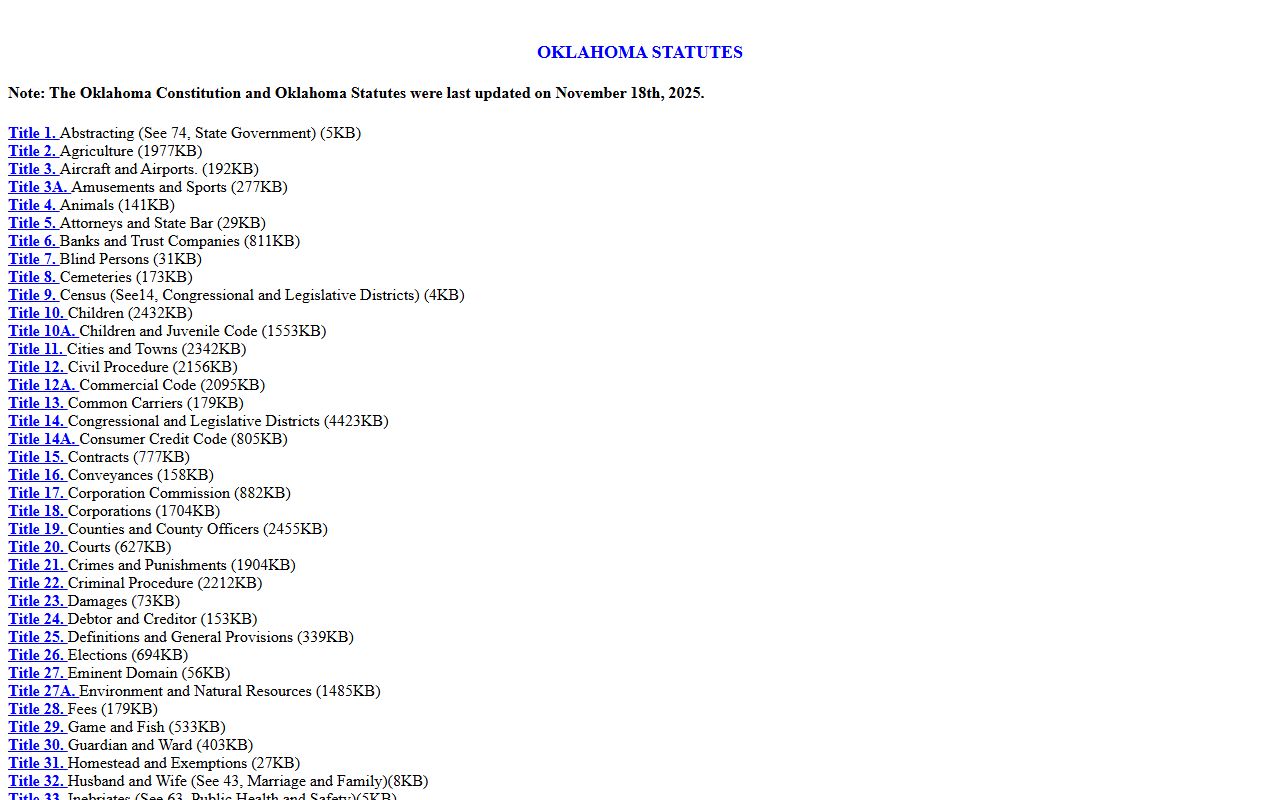
Title 58 holds the probate procedure statutes that govern estate administration across the state. Because every county uses the same code, the steps in a McIntosh County estate match those in any other Oklahoma district court, which makes the statute a reliable guide to what each filing should contain.
Restricted McIntosh County Probate Files
Not every part of a probate file is open. Guardianship and conservatorship cases can hold sensitive medical and financial details about a protected person, and the court can restrict those portions. The docket may be visible while specific exhibits stay closed.
Personal identifiers add another layer of protection. Social Security numbers, financial account numbers, certain addresses, and medical records can be redacted or withheld. Oklahoma's open records law does not override a statute that makes a specific record confidential, so a sealed part can stay sealed even when the case is otherwise public.
To view a restricted portion, a person may need party status, an attorney's authority, or a court order. The Court Clerk can explain what is open and what requires more.
Note: A guardianship or conservatorship file can keep its medical and financial exhibits closed, so a McIntosh County request for that material may need a court order.
Federal Estate Matters Near McIntosh County
Most estate work stays in the District Court, but a few money matters land in federal court instead. When a person who has died or an estate is tied to a bankruptcy, that case runs through the U.S. Bankruptcy Court rather than the county Court Clerk. McIntosh County sits in the Eastern District of Oklahoma, and the federal courthouse is in Muskogee, not Eufaula.
You can review the federal bankruptcy court information on the Eastern District bankruptcy court site.
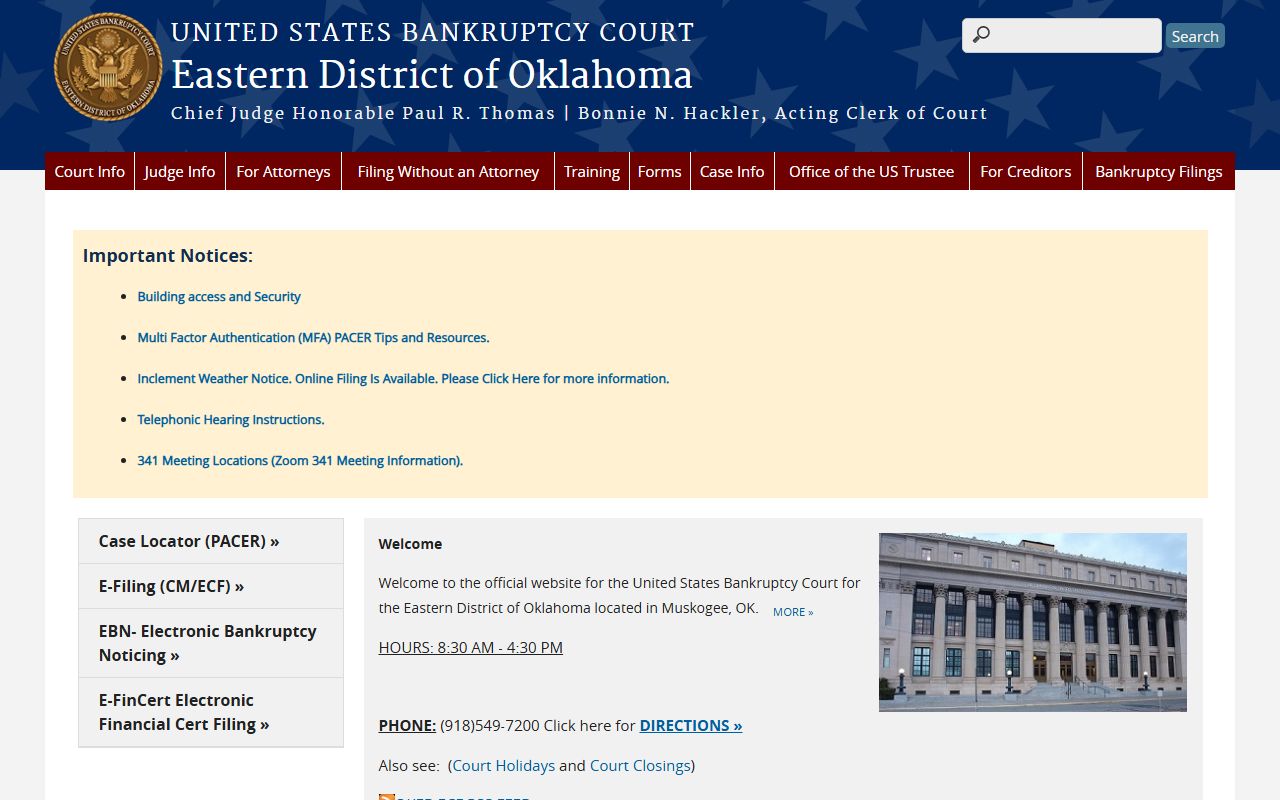
Federal records are searched through PACER, a system separate from ODCR. For a McIntosh County probate that involves only the local estate, the District Court and its Court Clerk remain the right office, and a broader case lookup runs through the McIntosh County court records portals. A certified copy of any estate order still comes from the Court Clerk who keeps the file.