
How to Search McIntosh County Traffic Records
Most McIntosh County traffic court records live on one site. That site is On Demand Court Records, known as ODCR, at www1.odcr.com. The Court Clerk links to it from the county court page. ODCR carries the McIntosh County District Court under the court value 046-. Pick that court, then set the case type to Traffic Tickets. You can search by driver name or by citation number. Results open as a docket, and a docket lists each case event in date order. The free side of ODCR handles these traffic lookups for McIntosh County with no charge.
Gather a few details first. A citation number finds one ticket fast. A name works too, in Last, First form. A filed-date range helps when a name is common.
- Open the ODCR portal at www1.odcr.com.
- Choose Oklahoma District Courts, then select McIntosh from the court list (court value 046-).
- Set the case type to Traffic Tickets, or enter the TR case number you already have.
- Add a driver name as Last, First, or a filed-date range, to narrow the list.
- Open the matching docket to read the charge, the court date, and the disposition.
The form takes more than it strictly needs, so leave blank what you do not know. The fields below cover a McIntosh County traffic search on ODCR.
| Field Label | Type | Required | Notes / Format |
|---|---|---|---|
| Court | Dropdown | Recommended | Select McIntosh; court value is 046- |
| Type of case | Dropdown | No | Choose Traffic Tickets or Declined Traffic Tickets |
| Party name | Text | Depends | Format is Last, First |
| Case number prefix | Dropdown | Depends | TR marks a traffic case |
| Case year | Dropdown | Depends | Two-digit year, 00 through 99 |
| Case number | Text | Depends | Numeric sequence after the prefix and year |
| Filed date range | Date | No | Start date through end date |
If ODCR returns a message that not enough information was provided, add a name or a citation number and run the McIntosh County search again.
Which Courts Handle McIntosh County Traffic Cases
Not every ticket lands in the same court. The McIntosh County Court Clerk processes citations written by the Oklahoma Highway Patrol and the McIntosh County Sheriff. Those cases run through the District Court in Eufaula. City police tickets are different. A citation from a town officer for a city ordinance usually goes to that city's municipal court, not the District Court.
The court named on the ticket tells you where to look. State and county citations show in a McIntosh County District Court search on ODCR. Municipal tickets may not. The table below sorts the two paths.
| Court | Traffic Cases Handled | Address |
|---|---|---|
| McIntosh County District Court | Highway Patrol and county sheriff citations | 110 N First St, Eufaula, OK 74432 |
| City Municipal Court | City ordinance and city traffic tickets | Check the court named on the citation |
The Court Clerk keeps the District Court traffic file, collects the fines, and tracks the costs. For a city ticket, the city court holds the case and takes the payment.
Note: Municipal traffic tickets may not appear in a McIntosh County District Court search, so check the city court printed on the citation when a ticket does not turn up online.
Types of McIntosh County Traffic Cases
McIntosh County traffic court records cover a wide range of driving offenses. Some are small. Some climb toward criminal charges. ODCR groups them under Traffic Tickets, and it also lists Declined Traffic Tickets, which are citations the system marks as declined. These are the common kinds you will see on a McIntosh County docket.
- Moving violations - speeding, running a light, or failure to yield.
- Equipment and non-moving - broken lights, expired tags, or no proof of insurance.
- Commercial vehicle - tickets tied to a commercial driver license.
- Serious traffic - reckless driving and like charges that can rise to a misdemeanor.
- Declined traffic tickets - citations the court system has flagged as declined.
The most serious driving cases do not stay on the traffic side. A charge such as driving under the influence is filed as a crime and moves to the criminal docket.
What McIntosh County Traffic Records Show
Open a McIntosh County traffic case and you see a structured file. The header carries the citation or case number and the court. Below it sit the charge, the court date, the plea, and the outcome. Money owed shows near the bottom. The table maps the common fields to what each one tells you.
| Field | What It Shows |
|---|---|
| Citation Number | The unique ID printed on the ticket and tied to the case |
| Charge / Statute | The offense and the law section the officer cited |
| Court Date | The appearance date listed on the citation |
| Plea | The driver's answer: guilty, not guilty, or no contest |
| Disposition | The current or final outcome of the case |
| Fine and Costs | The amount owed and the payment status |
| Warrant Activity | Any failure-to-appear or bench-warrant entry, when public |
The case number itself carries meaning. Oklahoma builds it from a prefix, a year, and a sequence, so a traffic file reads TR followed by the year and a number. In McIntosh County the TR prefix marks the case as traffic at a glance.
McIntosh County Citation or Name Search
Two paths lead to the same McIntosh County traffic record. You can search by citation number, or you can search by name. Each one fits a different situation, and each has a catch worth knowing before you start.
A citation number is the sharpest tool. It points to one ticket and skips the guesswork. The number sits on the paper citation, and a small typo can send the search nowhere, so copy it with care. Use it whenever you have the ticket in hand.
A name search casts wider. It helps when the ticket is lost or when you track a case for someone else. The trade-off is volume. A common name can return many McIntosh County matches, and you then sort by filed date or case type to find the right one. When a name returns too much, add a date range to trim the list.
Paying a McIntosh County Traffic Ticket
Many McIntosh County tickets can be paid online. ODCR runs a pay page at odcr.com/pay. It handles disposed cases that ended in conviction or another final outcome, including traffic, felony, misdemeanor, and wildlife matters. It also takes payment on an undisposed citation, but only after the driver enters a plea.
The ODCR pay page lays out which cases qualify and how the plea step works.
You can review the eligible-case rules on the ODCR pay-online page before you start.
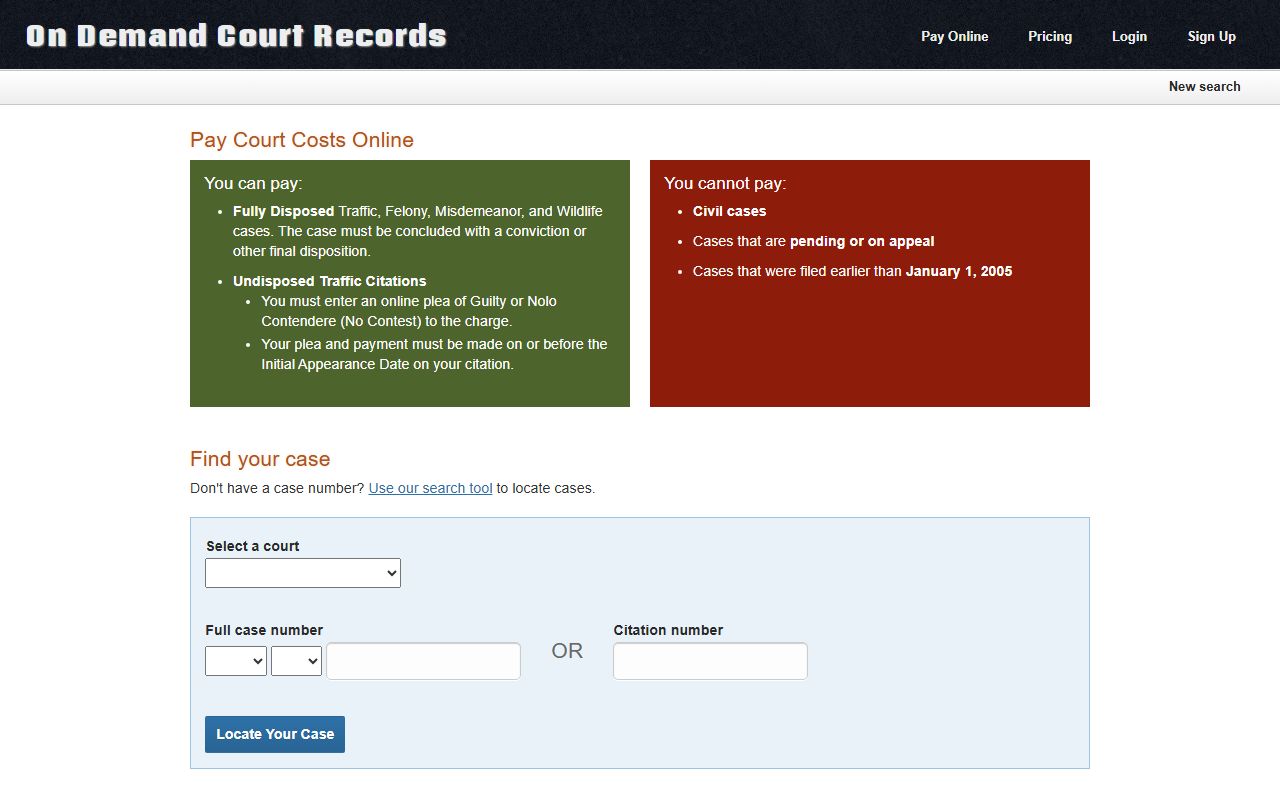
For an undisposed citation, ODCR asks for a plea of guilty or no contest, and the plea and payment must land on or before the appearance date on the ticket. There is a second route for some cases. The judiciary runs OSCN e-payments at pay.oscn.net, which takes payment by case number, citation number, or payment-plan number. Sample formats look like CM-2017-100, PP-OK-2019-25, or M972124. Only selected District Courts accept e-payments, and municipal or sheriff citations may use a different number format.
- Find out whether the ticket is a District Court case (Highway Patrol or sheriff) or a city citation.
- Search ODCR to confirm the case number and the current disposition.
- To pay a disposed case online, use ODCR Pay at odcr.com/pay and follow the eligible-case prompts.
- For an undisposed citation, enter a plea of guilty or no contest and pay on or before the appearance date on the ticket.
- To pay an eligible District Court case through the judiciary, use OSCN e-payments at pay.oscn.net by case, citation, or payment-plan number.
- To contest the ticket, appear in court on the listed date or call the Court Clerk about a not-guilty plea and a hearing.
Note: A guilty or no-contest payment can enter as a conviction in the McIntosh County court file and may carry over to the state driver record, so weigh that before you pay.
McIntosh County Traffic Record Access
Oklahoma law leans toward openness. The Open Records Act treats records of public bodies as open unless another law makes them confidential. Court files fall under that rule, and so do most of the traffic dockets on ODCR and OSCN. Anyone can look, and no reason is needed. The online index is a convenience copy, so the Court Clerk's certified record controls when the two differ.
Key Statutes:
Oklahoma Open Records Act, 51 O.S. 24A.1-24A.20 - public records are open for inspection and copying unless a law makes them confidential.
OCCA Rule 2.6 - the online case search is a public convenience, and the court's case-management record controls when online data differs.
McIntosh County Record vs Driver Record
People mix these up often. The McIntosh County traffic court record is the case file. It lives with the Court Clerk or a city court. The state driver record is a separate file kept through Service Oklahoma and the Department of Public Safety. One shows the case. The other shows the license history. Pulling the wrong one wastes a trip.
Service Oklahoma explains how to order a motor vehicle report on its MVR ordering page.
The table below sets the two records side by side so you can pick the right one.
| Comparison Point | Court Traffic Record | State Driver Record |
|---|---|---|
| Record source | Court Clerk and District Court, or a city municipal court | Service Oklahoma and the Department of Public Safety |
| What it shows | Citation, charge, court date, plea, disposition, and fine | Driving history used for license purposes and license status |
| Where to access | ODCR or OSCN online, or the McIntosh County Court Clerk | A Service Oklahoma motor vehicle report request |
| How to correct errors | Ask the Court Clerk or raise it in the case | Contact Service Oklahoma or DPS through the MVR process |
The driving record is not open to just anyone. By law a person generally gets only their own report under 47 O.S. 6-117 unless a listed exception applies. A standard driving record summary runs $25 at a motor license agency or through Service Oklahoma. Do not treat the court docket as a full driver history, because the two files hold different things.
CDL and Commercial Driver Records
Commercial drivers should treat a ticket with extra care. A citation tied to a commercial driver license still shows in the McIntosh County District Court file like any other traffic case. The bigger effect lands on the license itself, and that lives on the state driver record kept through Service Oklahoma, not on the court docket.
A guilty plea or a paid fine can weigh more for a commercial license than for a regular one. McIntosh County's own pages do not publish commercial-license rules, so a CDL holder should confirm the options with the Court Clerk and check the state driver record before paying. The court file answers what happened in the case; the driver record answers what it does to the license.
McIntosh County DUI and DWI Cases
Driving under the influence is not a routine traffic ticket. In Oklahoma it is filed as a crime, so the case opens on the criminal docket rather than the traffic side. On ODCR a charge like this shows under a felony or misdemeanor case type, with the CF or CM prefix, not TR. The record then carries charges, bond, hearings, and a sentence if there is a conviction.
For the full case file, the charges, and the sentence, see the McIntosh County criminal court records.
Deferred Disposition and Defensive Driving
Oklahoma courts can hold a plea open under conditions before a conviction enters. A deferred outcome means the finding stays open, and the case may be dismissed once the driver meets the terms. That can keep a conviction off the record when the court allows it. How a court handles a deferred traffic case depends on the charge and the judge.
McIntosh County's published pages do not lay out a county defensive-driving course or a fixed deferred-disposition fee. Ask the Court Clerk what a McIntosh County traffic case allows, since options and costs are set case by case. A deferred result can still touch the state driver record, so confirm that effect before you agree to terms.
Sealing McIntosh County Traffic Records
Some traffic records can be sealed. Oklahoma sets the categories and the steps for expungement in 22 O.S. 18 and 22 O.S. 19. Eligibility turns on the outcome and the timing, such as a dismissal, an acquittal, or a completed deferred sentence. A minor traffic case is not always the focus of an expungement, but a related criminal traffic charge may qualify.
An eligible person files a petition in the McIntosh County District Court, gives notice to the agencies that hold the record, and appears for a hearing if the judge orders one. If granted, the order tells the courts and the relevant agencies to seal public access. Sealing does not destroy every government copy, and some agencies may keep a restricted version for authorized use.
Note: Sealing a court traffic record does not by itself rewrite the state driver record, so a driver may need to confirm the license history separately with Service Oklahoma.
Fees for McIntosh County Traffic Records
Reading a McIntosh County traffic docket online is free. Copies cost money, and a certified copy costs a little more because the Court Clerk authenticates it. The state driving record carries its own set fee. Service Oklahoma takes individual motor vehicle report requests through its own portal.
You can start a state driving record order on the Service Oklahoma motor vehicle report page.
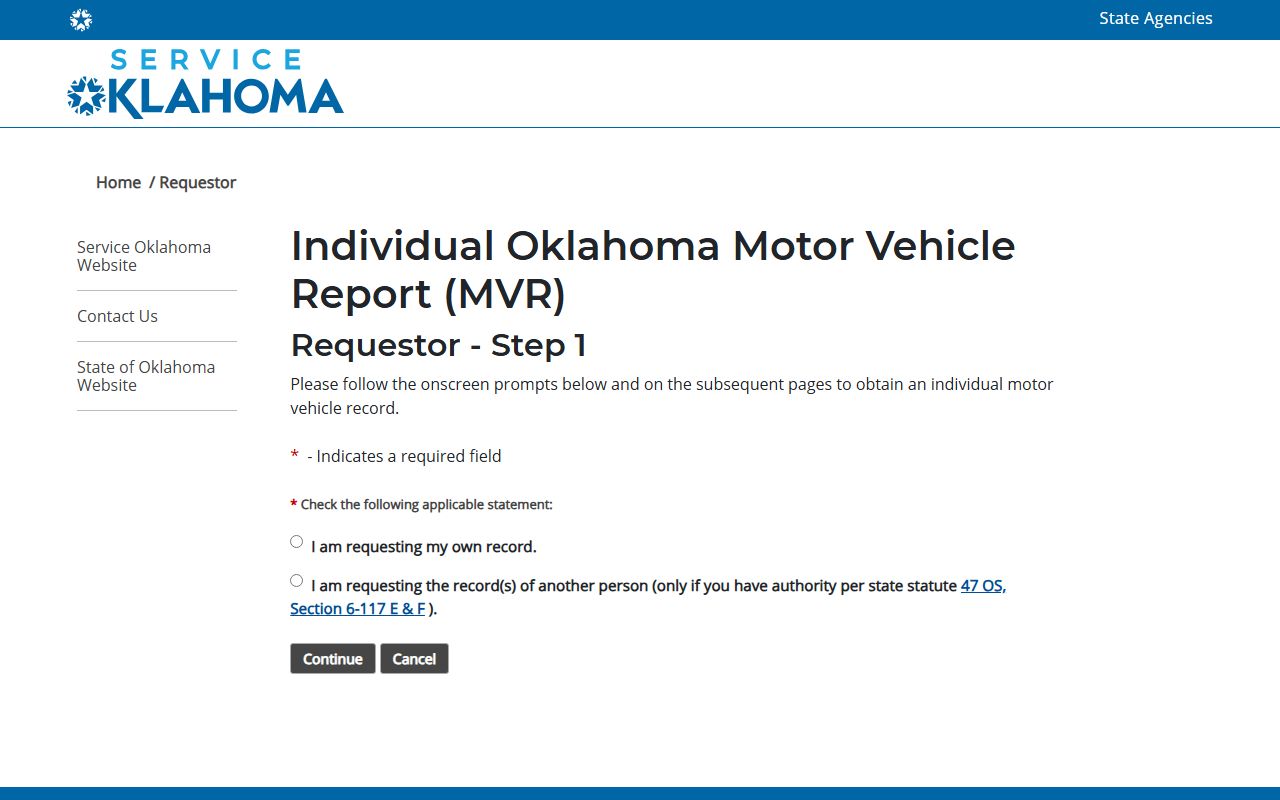
The portal asks whether the request is for your own record or for another person, and another person's record needs statutory authority. The table sets out the fees this page can confirm.
| Item | Amount |
|---|---|
| State driving record (MVR) | $25 |
| District Court traffic copy | Confirm with the Court Clerk |
| District Court certified copy | Confirm with the Court Clerk |
| County Clerk copy, per page | $1 |
One point keeps the offices straight. The County Clerk copy fee applies to county land and administrative records, not to court traffic files. For a traffic case copy or a certified court copy, the McIntosh County Court Clerk is the office to call.