
The McIntosh County District Court
The District Court is Oklahoma's court of general jurisdiction. That means it can hear almost any case, from a small civil dispute to a felony trial. McIntosh County has one District Court, housed in the courthouse in downtown Eufaula. The Court Clerk records, files, and keeps the permanent records for that court.
Oklahoma does not number its district courts the way Texas numbers its benches. There is no 12th or 250th District Court here. Instead, the state runs one district court per county, with a handful of judges who share the full caseload. A felony, a divorce, an estate, and a traffic ticket can all sit on the same court's calendar.
That single-court design keeps a McIntosh County case in one place. You search for it, file in it, and pull records from it through the same office.
Oklahoma's District Court Structure
Oklahoma builds its trial system around the district court. Every one of the state's counties has one, and McIntosh County's court is part of that statewide network. The district court sits at the base of the system as the trial level, where evidence is heard and judgments are entered.
Above the trial level, Oklahoma splits its top courts in two. The Oklahoma Supreme Court is the court of last resort for civil matters, and the Oklahoma Court of Criminal Appeals is the court of last resort for criminal matters. The Oklahoma Court of Civil Appeals handles civil appeals assigned through the Supreme Court. Below the district court, municipal courts deal with city ordinance and some municipal traffic cases.
So McIntosh County sits inside a clean ladder. City matters at the bottom, the District Court in the middle as the main trial court, and the state's two high courts at the top.
McIntosh County District Court Judges
A small bench runs the McIntosh County District Court. The county judges page lists a district judge, an associate district judge, and a special judge, and all three are reached through the same court scheduling line at 918-689-2232. Together they cover the criminal, civil, family, and probate work that comes through the court.
You can review the official roster on the county judges page.
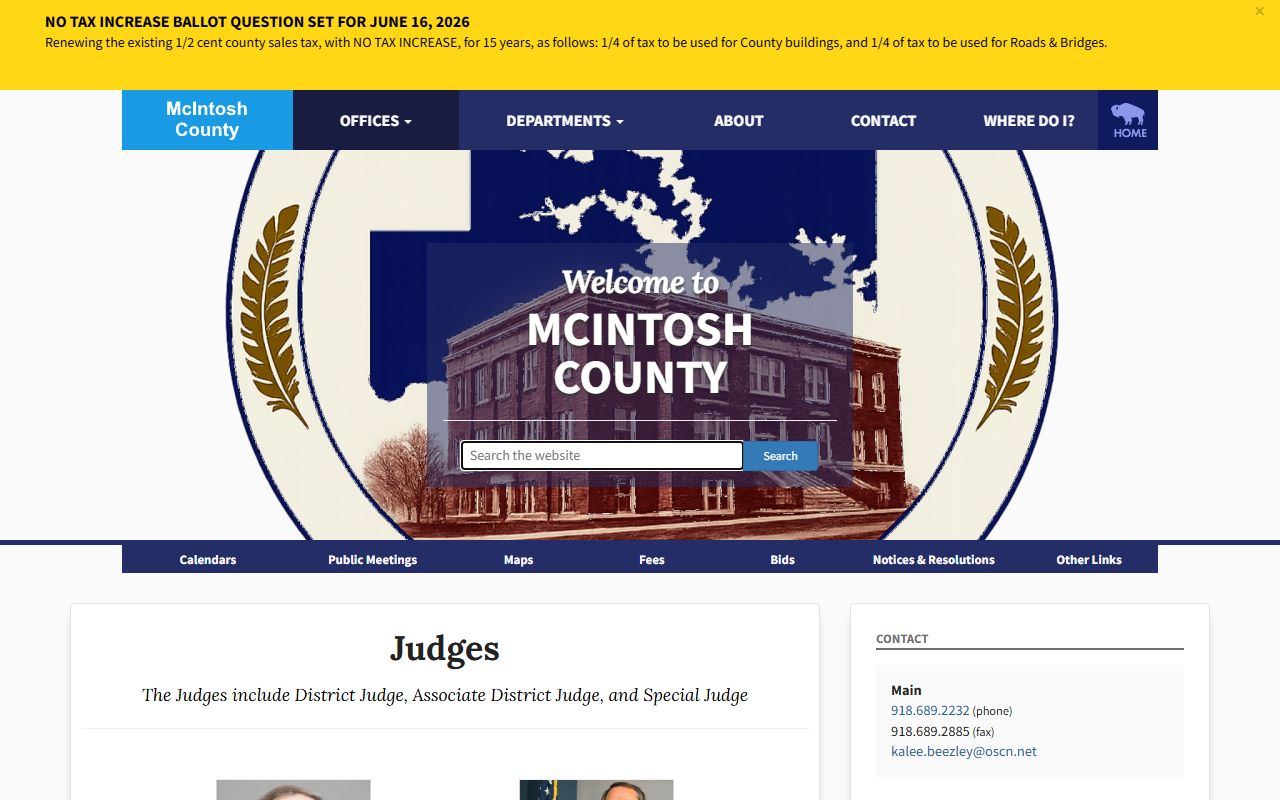
District Judge Mike Hogan presides over the court. Associate District Judge Brendon Bridges was elected in 2018 and reelected unopposed in 2022. His background gives a useful read on the court's breadth. He is an Eufaula High School graduate, earned a B.S. in Criminal Justice with a paralegal emphasis from Northeastern State University in 2006, and earned a J.D. with highest honors from the University of Tulsa College of Law in 2009. Before taking the bench he worked as a sole practitioner, with practice areas in criminal defense, civil litigation, estate planning, probate, government, and appellate work. Special Judge Brian McLaughlin rounds out the bench listed on the county page.
McIntosh County Court Clerk and District Attorney
Two offices shape how a District Court case is filed and prosecuted. The Court Clerk, Lisa Rodebush, records, files, and keeps the permanent records of the District Court. That office maintains the appearance dockets, processes filings across the civil, criminal, probate, juvenile, domestic, and small claims divisions, and collects court costs and fees. A copy or certified copy of any case record comes from this office.
The District Attorney handles the criminal side. Carol Iski is the DA for District 25, which covers both McIntosh and Okmulgee Counties. The DA reviews law-enforcement referrals, files charges, and prosecutes felony and misdemeanor cases in the District Court. Assistant District Attorneys Sara Dupree and Gregory R. Stidham also serve the district.
You can see the District Attorney's office details on the county district attorney page.
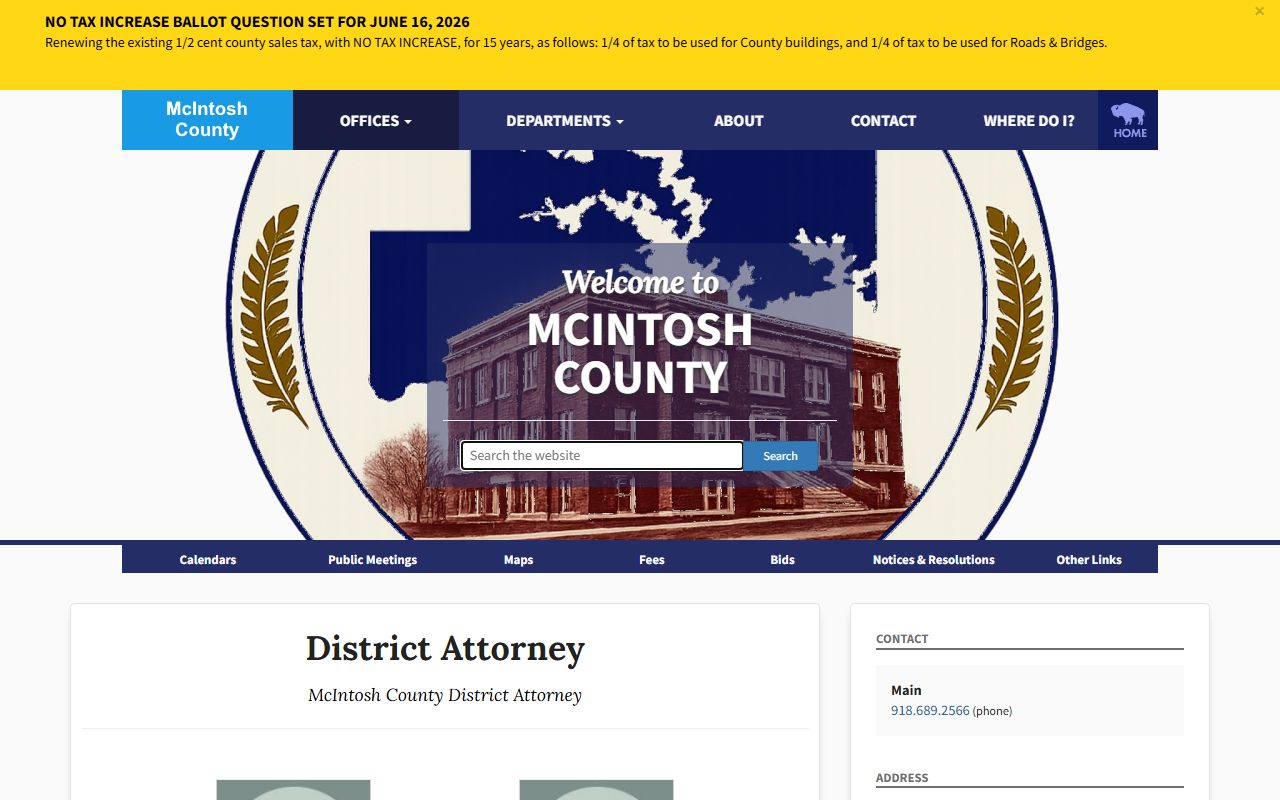
Together the two offices split the work. The DA decides what charges to file, and the Court Clerk keeps the record of every case once it opens.
What the McIntosh County District Court Hears
Because the District Court has general jurisdiction, its caseload is wide. The same court that sentences a felony also grants a divorce and approves an estate. The categories below show the main types of cases the court carries.
- Felony and misdemeanor criminal cases filed by the District Attorney.
- Civil suits, from large money claims to small claims under the statutory limit.
- Family and domestic cases, including divorce, custody, support, and paternity.
- Probate, guardianship, conservatorship, and trust matters.
- Traffic cases written by the Highway Patrol and the county Sheriff.
- Protective orders, mental health matters, and youthful offender cases.
City citations and city ordinance cases are the main exception. Those often route to a municipal court rather than the District Court, so a ticket from a city police officer may not appear in a District Court search.
McIntosh County District Court Divisions
The District Court organizes its work into divisions, but they all sit under one court and one Court Clerk. Civil, criminal, and family divisions handle the bulk of the calendar. The probate division handles estates and the legal care of protected people.
Probate is not a separate courthouse. It runs as a division of the District Court, and estate files live with the same Court Clerk. A deeper look at estates, wills, guardianships, and conservatorships sits with the McIntosh County probate records. Family cases such as divorce and custody fall in the domestic division, where sensitive details about children and finances can be sealed or redacted.
Note: Every division of the McIntosh County District Court reports to one Court Clerk, so a single office holds the civil, criminal, family, and probate files.
McIntosh County Courts and Offices
Several offices share the courthouse and keep the District Court running. The table below lists the court, the clerk, the prosecutor, and the lower municipal courts, with the address and phone for each.
| Court / office | Judge / officer | Address | Phone | Notes |
|---|---|---|---|---|
| McIntosh County District Court | District Judge Mike Hogan | 110 N First St, Eufaula, OK 74432 | 918-689-2232 | General jurisdiction trial court. |
| McIntosh County District Court | Associate District Judge Brendon Bridges | 110 N First St, Eufaula, OK 74432 | 918-689-2232 | Elected 2018, reelected unopposed 2022. |
| McIntosh County District Court | Special Judge Brian McLaughlin | 110 N First St, Eufaula, OK 74432 | 918-689-2232 | Special judge on the county bench. |
| Court Clerk | Lisa Rodebush | 110 N First St, Eufaula, OK 74432 | 918-689-2282 | Keeps District Court permanent records. |
| District Attorney, District 25 | Carol Iski | 110 N 1st St / PO Box 127, Eufaula, OK 74432 | 918-689-2566 | Covers McIntosh and Okmulgee Counties. |
| Municipal Courts | City-specific | Check the citation or city | Check the city | City ordinance and municipal traffic cases. |
District Court vs. Municipal Court
The District Court and a municipal court are not the same, and a record can sit in either one. The District Court is the county's general trial court. A municipal court is a city court that handles ordinance violations and some city traffic matters. The comparison below shows where the line falls.
| District Court | Municipal Court | |
|---|---|---|
| What it handles | County-wide trial court for civil, criminal, family, and probate cases | City court for ordinance violations within city limits |
| Case types | Felonies, misdemeanors, civil suits, divorce, probate, state and county traffic | City ordinance cases and municipal traffic citations |
| Where records live | McIntosh County Court Clerk, searchable on ODCR and OSCN | The issuing city court named on the citation |
Note: A city citation or municipal bench warrant may stay with the municipal court, so it can be missing from a McIntosh County District Court docket search.
McIntosh County District Court Dockets
A docket is the running list of events in a case. The Court Clerk keeps an appearance docket for each case filed, and the public can search those dockets online. McIntosh County links two systems for this. ODCR offers a free docket search and lists McIntosh in its court menu, while OSCN provides the statewide judiciary docket path.
Case numbers follow a set pattern of a prefix, a year, and a sequence, such as CF-2020-1. The prefix tells you the case type. Common McIntosh prefixes include CF for criminal felony, CM for criminal misdemeanor, CJ for civil, FD for family and domestic, PB or PR for probate, SC for small claims, TR for traffic, and PO for protective order. A fuller walkthrough of searching and reading these entries sits with the McIntosh County court dockets.
The online docket is a public convenience, not the official file. If the online data differs from the court's record, the court's case-management record controls.
How a Case Moves Through the System
Most cases start in the District Court and, if appealed, climb to the right state high court. The path splits by whether the case is civil or criminal, since Oklahoma sends those two streams to different courts of last resort.
Civil appeals: McIntosh County District Court › Oklahoma Court of Civil Appeals › Oklahoma Supreme Court
Criminal appeals: McIntosh County District Court › Oklahoma Court of Criminal Appeals
The Supreme Court assigns many civil appeals to the Court of Civil Appeals and remains the final civil authority. Criminal appeals go straight to the Court of Criminal Appeals, which is the last word on criminal matters in Oklahoma.
McIntosh County Courthouse Location
The District Court and its judges sit in the McIntosh County Courthouse in downtown Eufaula. The current building dates to 1927, raised after the old courthouse burned in July 1925. For court scheduling and judges' matters, the line is 918-689-2232. For case records and filings, the Court Clerk is the office to call.
McIntosh County District Court
110 N First St
Eufaula, OK 74432
918-689-2232
Mon-Fri 8:00 a.m. to 4:00 p.m.
The courthouse is a short drive east of U.S. 69 and near State Highway 9. The county does not publish parking, transit, or security-screening details, so a caller with questions about a hearing should reach the judges' office or the Court Clerk before arriving.
Appeals from the McIntosh County District Court
Not every case that touches McIntosh County stays in state court. Some matters belong to the federal system instead. McIntosh County sits in the U.S. District Court for the Eastern District of Oklahoma, and the federal courthouse is in Muskogee rather than Eufaula. Federal crimes, federal civil claims, and certain Indian Country criminal cases after the McGirt decision can land there.
Federal records are searched through PACER, a system apart from the state's ODCR and OSCN. So a case tied to tribal citizenship or a reservation boundary may run in federal court even when the conduct happened in the county. For a state case, appeals from the District Court follow the civil or criminal path through Oklahoma's high courts.
For the records side of any District Court case, the Court Clerk remains the source for copies and certified copies, and a broad case lookup runs through the county court systems.