
How to Search McIntosh County Court Records
Court records in McIntosh County are searched online through two state-linked systems. On Demand Court Records, known as ODCR, gives the most direct public path to McIntosh County District Court cases. The Oklahoma State Courts Network, or OSCN, offers a second statewide route to the same dockets. The county Court Clerk links both tools from its own office pages. A search on the ODCR portal is free and covers party names, case numbers, and filing dates. OSCN lists McIntosh County District Court in its court dropdown as well. Either route can confirm whether a case exists and what has happened in it.
A name or a case number speeds any search. The portal asks for a last name and first name, or a full case number with its prefix and year. A filing date range helps narrow a common name. Most docket detail is free to view. Scanned document images sit behind a paid subscription, and that image level is limited to active bar members.
- Open ODCR and choose McIntosh from the court list, or pick McIntosh County District Court on OSCN.
- Enter a party name as Last, First, or type a full case number with its prefix.
- Narrow the result by case type, party type, or a filed date range.
- Review the docket sheet for parties, charges, hearings, and the disposition.
- Ask the Court Clerk for a certified copy when an official document is needed.
The ODCR form lays out each field a searcher fills before running a query. The table below mirrors the public search fields that the portal exposes for McIntosh County District Court.
| Field Label | Type | Required | Options / Format Notes |
|---|---|---|---|
| Court group | Dropdown | Optional | All Courts, Oklahoma District Courts, or Tribal Courts |
| Court | Dropdown | Recommended | McIntosh District Court appears with the value 046- |
| Party name | Text | Optional | Entered as Last, First |
| Party type | Dropdown | Optional | Plaintiffs and Defendants, or All Parties |
| Type of case | Dropdown | Optional | Felony, misdemeanor, traffic, probate, family, small claims, and more |
| Case number prefix | Dropdown | Optional | Common prefixes such as CF, CM, CJ, FD, PB, SC, TR |
| Case year | Dropdown | Optional | Two-digit year from 00 to 99 |
| Case number | Text | Optional | Numeric sequence after the prefix and year |
| Filed date range | Date inputs | Optional | Start date to end date |
| Activity date | Date input | Optional | A single date |
If too little is entered, the site returns a notice asking for more search information. The screen below shows the public ODCR search form, found at the ODCR public court search.
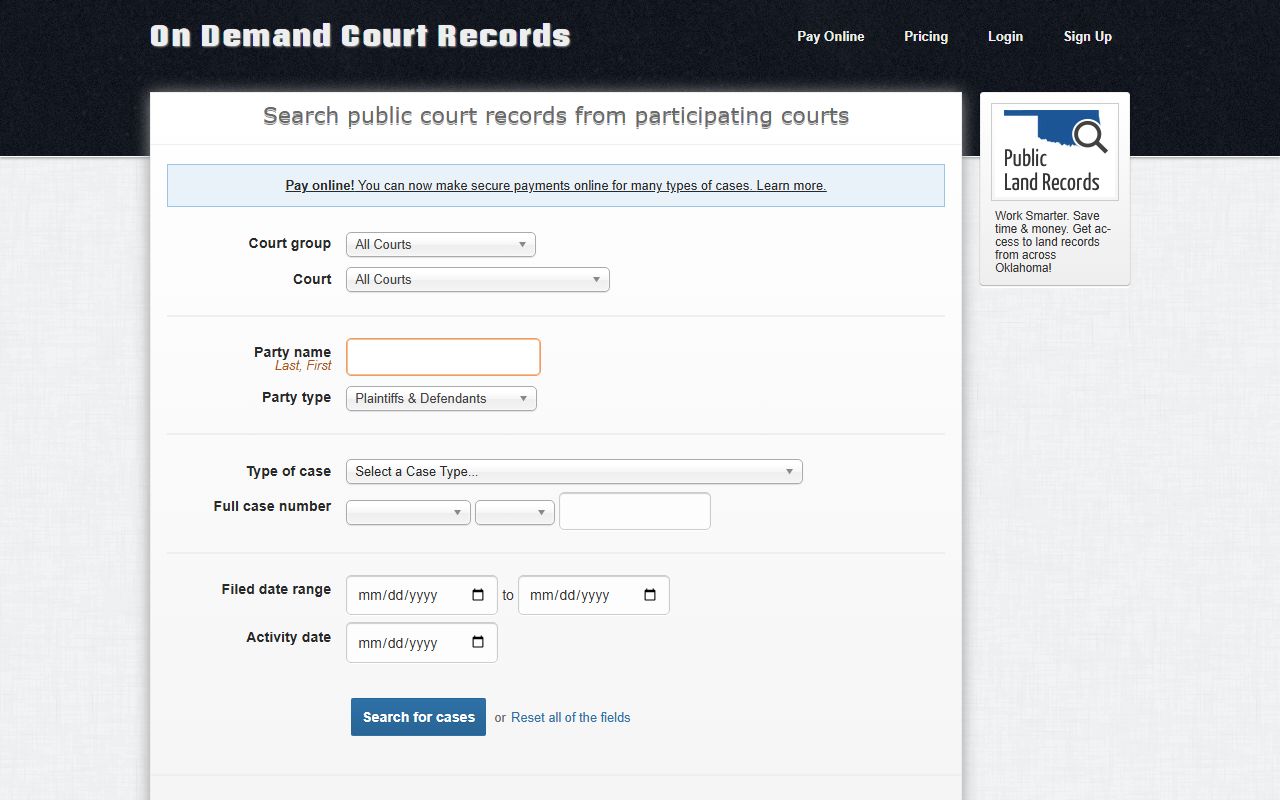
The form returns a docket list once a name or case number matches a McIntosh County District Court file. Add a date range or case type when a common name brings back too many hits.
Note: Municipal citations and city ordinance cases may not appear in a District Court search, so check the issuing city court named on the ticket.
The McIntosh County Judicial System
Oklahoma has two courts of last resort. The Oklahoma Supreme Court handles civil matters, and the Oklahoma Court of Criminal Appeals handles criminal ones. The Oklahoma Court of Civil Appeals reviews civil appeals assigned through the Supreme Court. Below them sits the trial court. For McIntosh County, that trial court is the District Court, and it hears the broadest range of cases. Municipal courts handle city ordinance violations and some municipal traffic matters on a separate track.
Three judges serve the McIntosh County District Court. District Judge Mike Hogan presides over the general docket. Associate District Judge Brendon Bridges, an Eufaula High School graduate, was elected in 2018 and returned unopposed in 2022. Special Judge Brian McLaughlin rounds out the bench. Criminal charges reach the court only after the District Attorney files them, following a referral from law enforcement.
Case flow: Municipal Court › District Court › Court of Civil Appeals › Oklahoma Supreme Court for civil cases, and District Court › Oklahoma Court of Criminal Appeals for criminal cases.
| Court | Jurisdiction | Case Types |
|---|---|---|
| Municipal Court | City limits | Ordinance violations, municipal traffic |
| District Court | McIntosh County | Felony, misdemeanor, civil, family, probate, traffic, small claims |
| Court of Civil Appeals | Statewide | Assigned civil appeals |
| Court of Criminal Appeals | Statewide | Criminal appeals |
| Supreme Court | Statewide | Final civil review |
OSCN serves as the statewide window into these dockets. Its docket landing page offers an OSCN search, a non-OSCN county search, and a help section, as shown at the OSCN docket search page.
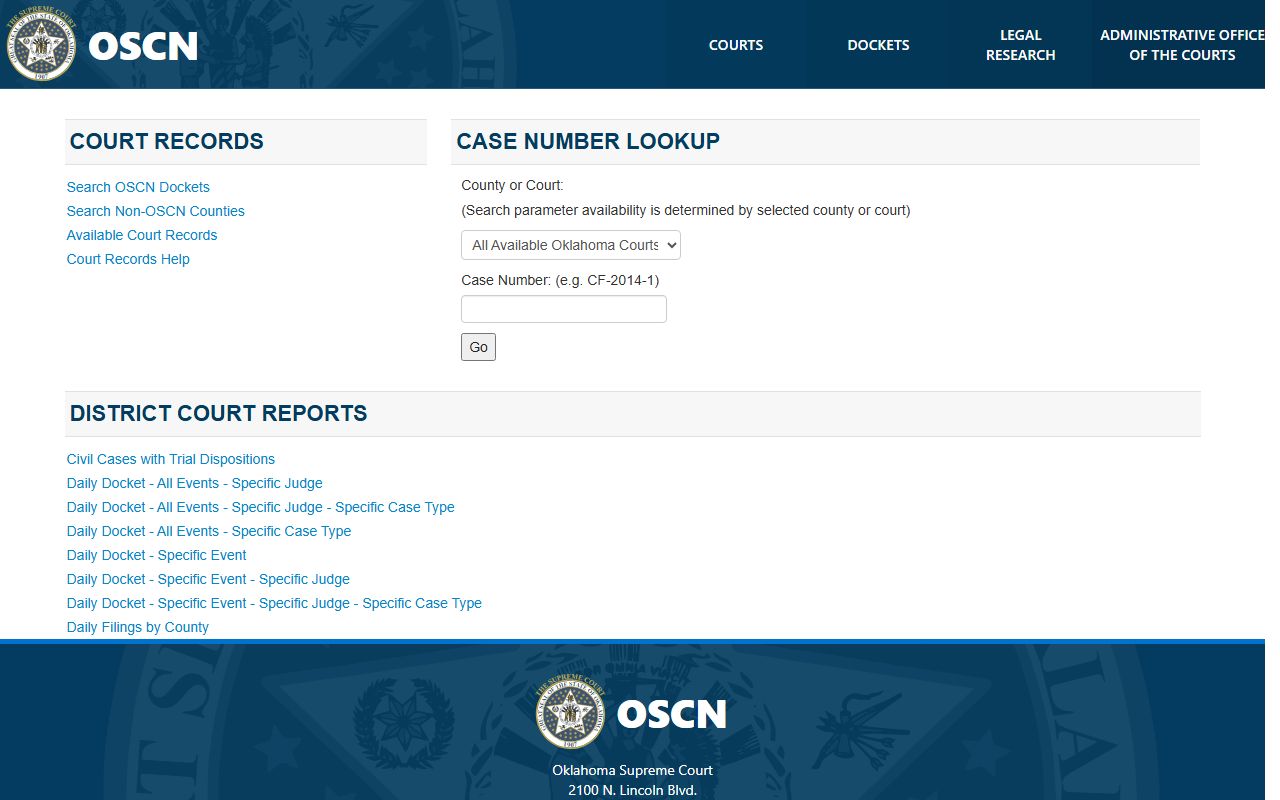
OSCN lists McIntosh County District Court among its searchable courts, giving the public a second path to the same case files.
Types of Court Records Available in McIntosh County
The McIntosh County Court Clerk keeps the permanent records of the District Court. Those records span many divisions. Civil, criminal, family, probate, juvenile, small claims, traffic, marriage, and protective order files all flow through the same clerk. The office also processes traffic citations written by the Oklahoma Highway Patrol and the county sheriff.
Land deeds, plats, and county board minutes are a different matter. Those belong to the County Clerk, not the Court Clerk, and they sit outside the court record set. Knowing which office holds a record saves a wasted trip.
- Criminal records - felony and misdemeanor cases with charges, pleas, bonds, and sentences.
- Civil records - money claims, judgments, liens, garnishments, and small claims under the set limit.
- Family and divorce records - dissolution, custody, support, and paternity cases held by the Court Clerk.
- Probate records - estates, wills, guardianships, and conservatorships filed in the District Court.
- Traffic records - state and county citations, with city tickets routed to municipal court.
Juvenile and youthful offender matters appear in the case-type list, yet state law keeps most of that content confidential. Protective orders show up too, though addresses and minor details are often withheld for safety. The Court Clerk's role and duties are described on the county Court Clerk office page.
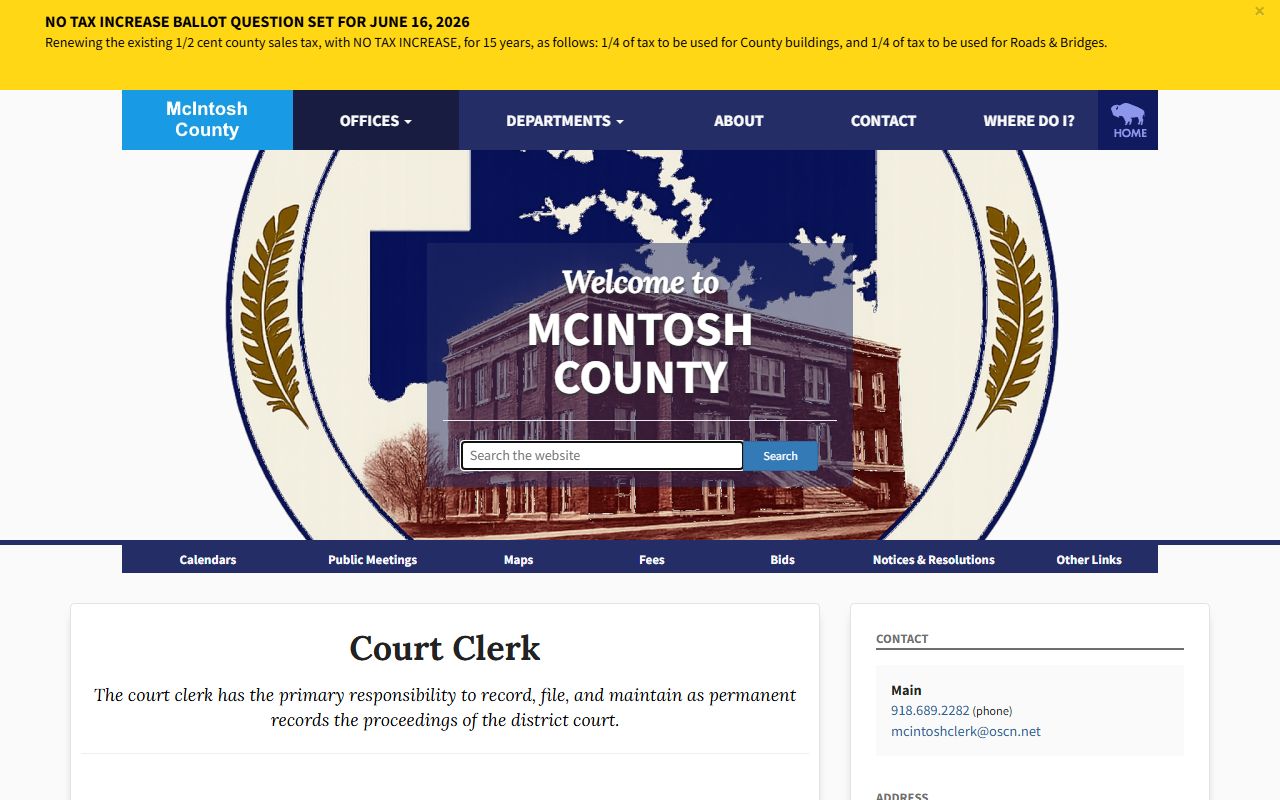
The Court Clerk page confirms the office records, files, and keeps the permanent records of all District Court proceedings in McIntosh County.
What McIntosh County Court Records Show
A McIntosh County court record holds a fixed set of fields. The docket sheet ties them together in date order. Each entry adds a piece to the story, from the first filing to the final order. The table below breaks down the most common fields a searcher sees.
| Field | What It Shows |
|---|---|
| Case Number | The unique code with prefix, year, and sequence |
| Filing Date | The day the case opened with the clerk |
| Parties | Plaintiffs, defendants, petitioners, and respondents |
| Charges / Cause | The counts, statute citations, or civil claims at issue |
| Disposition | The current or final outcome of each count |
| Sentence / Judgment | The penalty, award, or court order entered |
The case number itself tells you the kind of case. McIntosh County uses standard Oklahoma prefixes. CF marks a felony, CM a misdemeanor, and CJ a civil matter. FD covers family and domestic cases, while PB flags probate. SC is small claims, TR is traffic, and PO is a protective order. ML stands for a marriage license, WL for the filing of a will, YO for a youthful offender, and SW for a search warrant.
Docket events list hearings, bonds, warrants, and payment activity as they happen. Attorney names appear once entered. The judge assigned to the case shows near the top of the sheet.
Public Access Laws for McIntosh County Court Records
Oklahoma law treats court and public-body records as open by default. The Open Records Act sets that baseline, and a handful of related statutes shape how it works in practice. Records stay public unless a separate law makes a specific file confidential. The statutes below carry the most weight for McIntosh County court records.
Key Statutes:
Oklahoma Statutes § 51 O.S. 24A.1-24A.20 - the Open Records Act makes public-body records open unless another law makes them confidential.
Oklahoma Statutes § 51 O.S. 24A.5 - records may be inspected and copied during business hours, subject to listed confidentiality exceptions.
Oklahoma Statutes § 51 O.S. 24A.8 - law enforcement agencies must release certain arrest and incident facts, though investigatory limits still apply.
OCCA Rule 2.6 - online case search is a public convenience, but the court's own case-management record controls if the two differ.
Oklahoma Statutes § 22 O.S. 18 and 19 - eligible people may petition to seal arrest and court records under listed categories.
Oklahoma Statutes § 10A O.S. - many juvenile court, agency, and social records are kept confidential by statute.
The practical rule is simple. Start with ODCR or OSCN for a docket. If the file is not online, contact the McIntosh County Court Clerk by phone, mail, or counter visit. Expect to pay for copies and certifications.
Records That Are Restricted or Confidential
Open access has limits. Some McIntosh County court records are closed to the public or heavily redacted. Juvenile case files top that list, along with adoption records and mental health proceedings. Sealed and expunged files drop off the public docket entirely. Personal identifiers also get masked, including Social Security numbers, financial account numbers, some addresses, and the names of minors.
Sealing a record takes a court order. An eligible person files an expungement petition in the District Court, usually under the adult criminal categories in state law. Eligibility turns on the outcome and timing, such as an acquittal, a dismissal, or a completed deferred sentence after a waiting period. The petitioner notifies the prosecuting and record-holding agencies, pays the costs unless waived, and appears at a hearing if the judge requires one.
If the judge grants the request, the order directs courts, law enforcement, and the state bureau to seal or restrict public access. A sealed record is not always destroyed. Some agencies keep it for authorized law-enforcement or court use.
Note: Open records law does not override a statute that makes a specific record confidential, so a closed file stays closed even though most court records are public.
Specialty Courts in McIntosh County
Oklahoma supports treatment-based dockets, and the ODCR case-type list includes Drug Court and the Anna McBride Act Mental Health Court. Those options appear in the statewide search tool that covers McIntosh County. They route people with substance or mental health needs toward supervision instead of a standard sentence.
The county does not publish a separate specialty-court page, a participant handbook, eligibility rules, or a named local coordinator. Because of that, treatment cases in McIntosh County are best understood as running through the District Court itself. They appear in the public search only to the extent that the docket is open. Any diversion or treatment offer in a criminal case would involve the District Attorney and a judge's approval.
McIntosh County Sheriff and Jail
The McIntosh County Sheriff preserves the peace, operates the county jail, and serves the warrants and process ordered by the District Court. Sheriff Kevin Ledbetter has held the office since 2024. The sheriff's office and jail sit on Industrial Drive in Eufaula, away from the downtown courthouse. The main line reaches the office during business hours, and a separate dispatch number covers after-hours calls.
The county does not post an online jail roster. To confirm whether someone is in custody, call the sheriff's office during the day or dispatch after hours. Statewide tools fill the gap as well, since VINE offers custody notifications and the Oklahoma Department of Corrections lists sentenced state inmates. The county sheriff page describes these duties at the official sheriff office page. For the full booking picture, see the McIntosh County inmate records page, and check warrant records for outstanding warrants.
Note: Booking and arrest files held by the sheriff are not District Court records, so a court docket search may not show current jail status.
Marriage, Divorce, and Probate Records
The McIntosh County Court Clerk issues marriage licenses and files the returned certificates. Divorce cases run through the same District Court as domestic matters, and the clerk keeps those files too. A license issued in McIntosh County stays valid statewide, though it should return to the issuing clerk after the ceremony. For the full process and fee details, see the marriage and divorce records page.
Probate is not a separate court here. Estates, wills, guardianships, and conservatorships are filed in the District Court and held by the Court Clerk. A probate file can include the petition, notices, letters of appointment, an inventory, creditor claims, and the final decree. The probate records page covers searching and copying those files. A few legal terms come up again and again in estate cases.
- Testator
- The person who made the will being offered for probate.
- Executor
- The person named in a will to carry out its terms and settle the estate.
- Conservator
- A person appointed by the court to manage the finances of someone who cannot.
- Intestate
- A death with no valid will, which sends the estate through state succession rules.
McIntosh County Court Records Fees
Fees vary by which office holds the record. The County Clerk publishes a clear schedule for recording, copies, and open-records requests. Those charges cover land and county administrative documents, not court case files. The table below lists common County Clerk fees from the official fee page.
| Item | Amount |
|---|---|
| Plain copy per page | $1 |
| Certified copy per certification | $1 |
| Open records, standard page up to 8.5 x 14 | $1 |
| Emailed open-records page | $0.15 |
| Real estate recording, first page | $8 |
| Additional page or exhibit | $2 |
| Commercial search and redaction labor | $17.63 per hour, one-hour minimum |
These amounts come from the county fee page, and estimated charges above $75 may require prepayment. Court filing and copy fees for District Court cases are a different set. The county fee page does not list them, so confirm those rates directly with the Court Clerk before sending a request.
Note: The County Clerk fees above apply to recorded land and administrative documents, while District Court filing and copy costs must be verified with the Court Clerk.
How to Interpret McIntosh County Court Records
A docket can read like code at first. A few key terms clear up most of the confusion. The biggest one is the gap between a charge and a conviction. A charge is only an accusation filed by the prosecutor. A conviction is a judgment of guilt entered by the court. A person can face a charge that ends in a dismissal, an acquittal, or a reduced count, so the charge alone never proves guilt.
The disposition field tells the real outcome. It shows whether a count was dismissed, pleaded, tried, or deferred. A deferred result means the plea or finding is held open under conditions. If the person meets those conditions, the case may close without a final conviction. A sentence, by contrast, is the punishment or order that follows an actual conviction.
Bonds, warrants, and continuances also fill the docket. A bench warrant usually points to a missed court date. A continuance simply pushes a hearing to a later day. Reading these entries in order shows how a McIntosh County court case moved from filing to close.
Accuracy and Record Limitations
Online dockets are a convenience, not the official file. The data updates on a schedule, and a recent filing may not show right away. A court rule states plainly that the case-management record controls when the online version differs. For anything used in a legal or formal setting, a certified copy from the Court Clerk is the reliable source.
History adds another limit in McIntosh County. The old courthouse burned in 1925, and many records were lost. Files from before that fire may be thin or missing, so older land, probate, and marriage research sometimes needs alternate sources.
Note: Always confirm a name, date, or outcome with the originating office before relying on an online McIntosh County court record for any important decision.
History of McIntosh County Courts
McIntosh County was created at Oklahoma statehood in 1907, with Eufaula as the county seat. County governments formed in part so residents would not have to travel more than a day to reach the seat for land and record business. The first county clerk, Edward C. Julian, was so devoted to keeping the county records that local history ties him to a deadly dispute over them. That story survives as a symbol of how much record preservation has always mattered here.
The old courthouse burned in July 1925, and many county records were lost in the fire. The current courthouse was built in 1927 and still serves the county today. That single event explains why pre-1925 court, land, and probate files can be uneven. Some earlier records did survive, but the set is incomplete.
Modern preservation looks far different. The County Clerk has digitized records and moved original books, already scanned, into underground salt-mine storage in Kansas. The office describes that vault in concrete terms, as detailed at the County Clerk office page.
The page reports that digitized books rest 650 feet below ground, wrapped in 400 feet of rock salt, in cool, dry, stable conditions near 70 degrees. That care protects the county's record history for the long term.
McIntosh County Courthouse Location and Contact
The McIntosh County Courthouse stands in downtown Eufaula. It houses the District Court judges, the Court Clerk, the County Clerk, the District Attorney, the treasurer, and several other county offices. The sheriff and jail are the main exception, since they operate from a separate site on Industrial Drive. Most offices keep weekday hours from morning to mid-afternoon.
The county posts each office, its phone line, and its hours on the official contact list, shown at the county contact page.
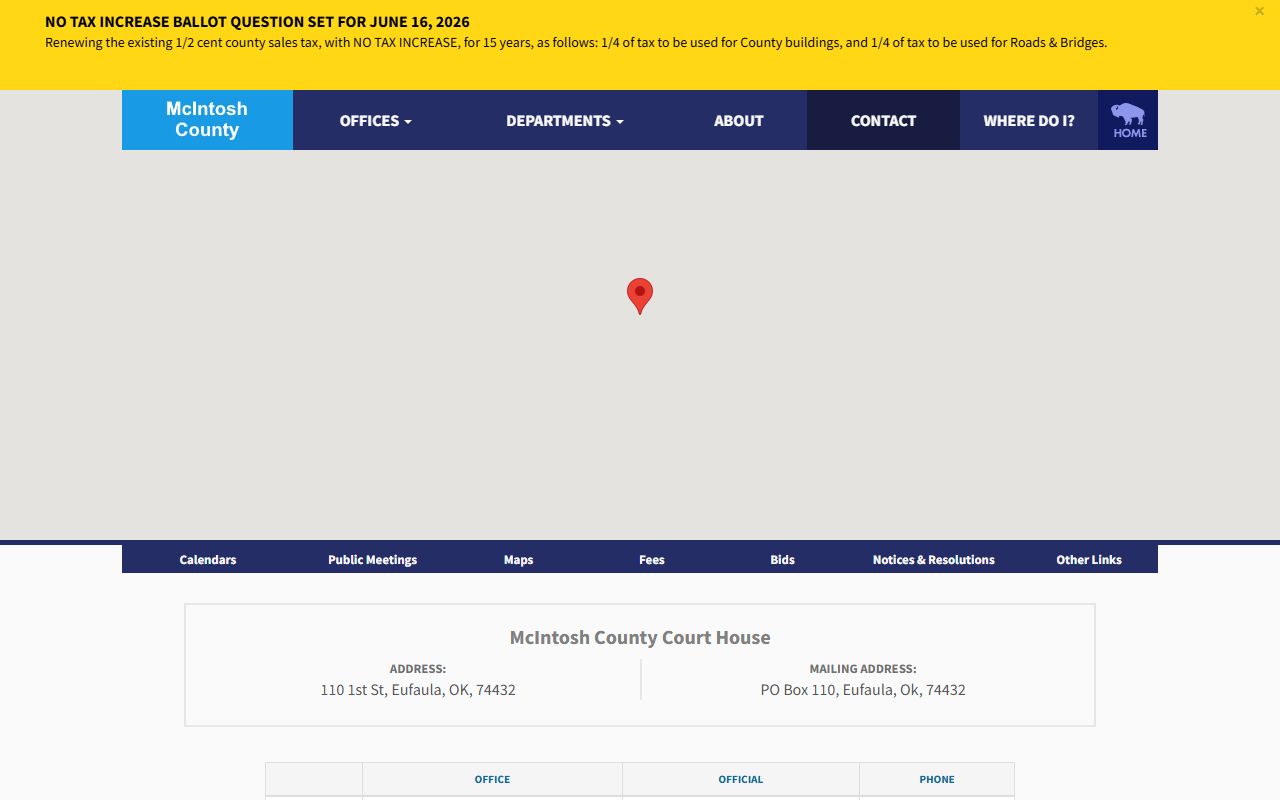
The contact list names the Court Clerk, County Clerk, judges, sheriff, and District Attorney, each with a direct phone number. The county also keeps a broader hub of notices and office links, pictured below from the McIntosh County homepage.
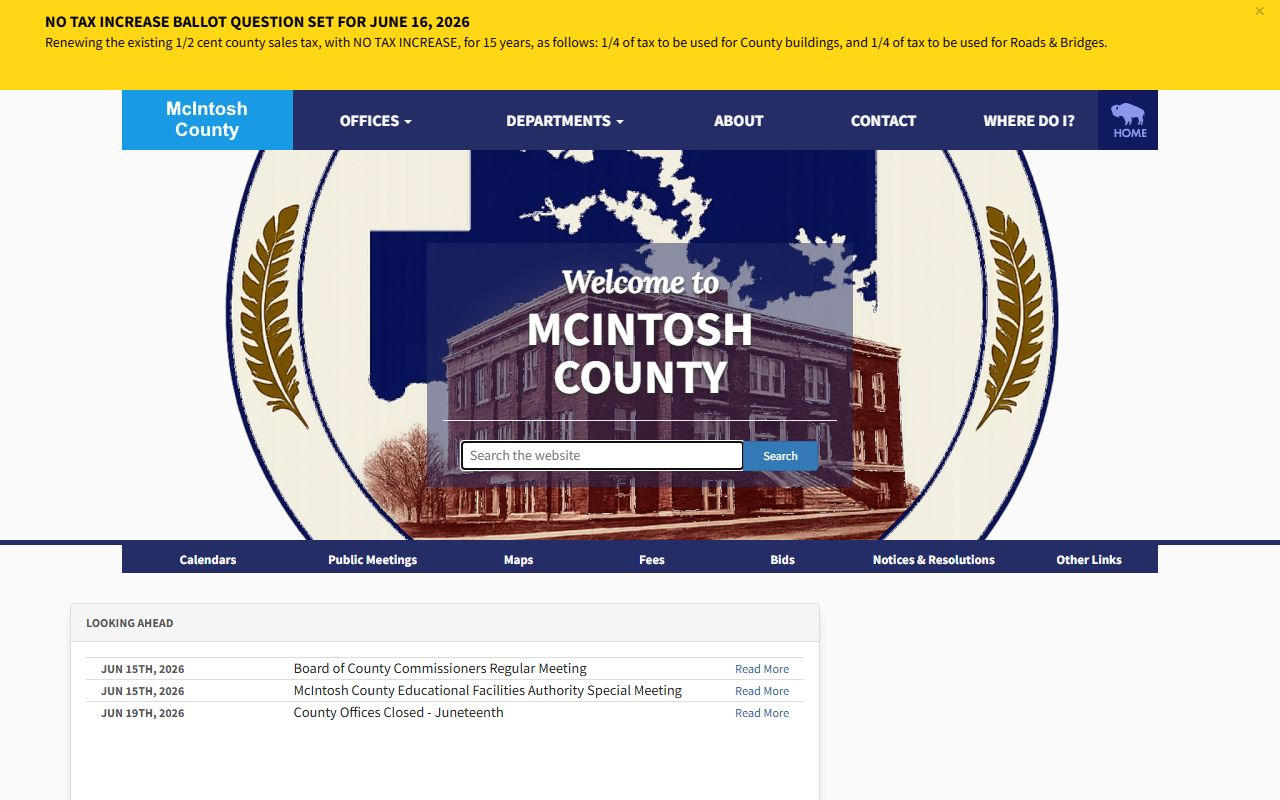
From the homepage, visitors reach county offices, current notices, and the links to court-record search tools in a single place.
Frequently Asked Questions
How do I search McIntosh County Court records for free?
Use ODCR first. The portal offers free docket searches by party name, case number, and filing date for McIntosh County District Court. OSCN provides a second free path to the same dockets. Both show case events, parties, and disposition. Only scanned document images carry a fee, and that level is reserved for active bar members.
What does each case number prefix mean?
The prefix marks the case type. CF is a felony and CM a misdemeanor. CJ is a civil case, FD is family or domestic, and PB is probate. SC marks small claims, TR is traffic, and PO is a protective order. ML covers a marriage license, WL a will filing, YO a youthful offender, and SW a search warrant.
Why can I not find a city traffic ticket in the court search?
City citations often run through a municipal court, not the District Court. ODCR and OSCN cover District Court cases, including state and county tickets, but municipal ordinance matters stay with the issuing city. Check the court named on the citation itself to find the right office.
Are McIntosh County court records open to the public?
Most are. Oklahoma's Open Records Act treats court and public-body records as open unless a separate statute closes them. Juvenile files, adoption records, sealed cases, and certain personal identifiers stay confidential. Everything else can be inspected and copied, subject to fees and normal business hours.
How do I get a certified copy of a court record?
Contact the McIntosh County Court Clerk. Certified copies come from the clerk's office, not the online portal, and they are the version accepted in legal settings. You can call, mail a request, or visit the counter in Eufaula. Confirm the current copy and certification fees with the clerk before sending a request.
Can I clear an old record from the public docket?
Sometimes. An eligible person files an expungement petition in the District Court under the adult criminal categories in state law. Eligibility depends on the outcome and timing, such as a dismissal, an acquittal, or a completed deferred sentence. If a judge grants the order, courts and agencies seal or restrict public access to the file.
How do I check whether someone is in the county jail?
The county does not post an online roster. Call the sheriff's office during business hours, or dispatch after hours, to confirm custody status. Statewide, VINE offers custody notifications and the Oklahoma Department of Corrections lists sentenced state inmates. Booking files are sheriff records, not District Court records.