
How to Find a McIntosh County Inmate
Start with the Sheriff's Office. It runs the county jail and knows who is in custody right now. During business hours the main line is 918-689-4357. After hours, on weekends, or late at night, county dispatch answers at 918-689-2526. You can also go in person to the office at 1425 Industrial Dr in Eufaula. Staff can confirm whether a person is held, when they were booked, and whether they have been moved.
State tools cover the rest. Oklahoma VINE, at vinelink.vineapps.com, lets you check custody status and sign up for notifications. The Oklahoma Department of Corrections offender lookup, at okoffender.doc.ok.gov, tracks people who have been sentenced to state prison. Between these channels you can locate most people connected to a McIntosh County case. The order of steps below works for a county jail search.
- Call the Sheriff's Office at 918-689-4357 during the day, or county dispatch at 918-689-2526 after hours.
- Have the full name, and a date of birth if you know it, ready before you call.
- Check Oklahoma VINE for current custody status and to set up alerts.
- Search the Oklahoma DOC offender lookup if the person has been sentenced and sent to state prison.
- Ask whether the person has been transferred, released, or held for another agency.
Why McIntosh County Has No Online Jail Roster
Many Oklahoma counties post a live inmate roster, but McIntosh County does not. No official county jail roster or inmate-search interface was located on the county website. Third-party sites sometimes scrape this kind of data, yet those pages are not official and may be wrong or out of date. The reliable answer comes straight from the Sheriff's Office or from the statewide systems built for custody tracking.
That gap shapes how a McIntosh County inmate search works. There is no name box to type into on a county page. Instead, each official tool covers a slice of the picture. The table lists the channels that do exist, the fields they accept, and what each one can and cannot tell you.
| Portal | Field | Type | Required | Notes |
|---|---|---|---|---|
| McIntosh Sheriff website | None located | n/a | n/a | No official county jail roster was found; call the Sheriff's Office |
| Oklahoma DOC Offender Lookup | Search and Fugitives navigation | Web lookup | Unspecified | State sentenced offenders, not county pretrial jail holds |
| Oklahoma VINE | State custody notification search | Web lookup | Unspecified | Custody status and alerts; separate from the full jail booking file |
Note: Third-party jail roster sites are not official McIntosh County sources, so confirm any custody detail with the Sheriff's Office or a statewide system before relying on it.
McIntosh County Sheriff's Office and Jail
The Sheriff's Office is the single most useful contact for inmate questions. Sheriff Kevin Ledbetter leads the office, which has the authority to operate the county jail and to hold people charged with a felony or a breach of the peace. The office sits on Industrial Drive in Eufaula, not at the downtown courthouse. Keep both the main number and the dispatch number handy, since each one serves a different time of day.
McIntosh County Sheriff's Office
1425 Industrial Dr
Eufaula, OK 74432
918-689-4357
After hours / dispatch: 918-689-2526
Mon-Fri 8:00 a.m. to 4:00 p.m.
The Sheriff also accounts for office fees and serves warrants and papers ordered by the District Court. For custody questions, the front desk during the day and dispatch after hours are the right places to start.
McIntosh County Jail vs Oklahoma DOC Custody
County jail and state prison are two different things, and they hold different people. The McIntosh County jail holds people who were just arrested, who are waiting for a court date, or who are serving a short local sentence. Once a court sentences someone to a longer term in state prison, custody shifts to the Oklahoma Department of Corrections. That move can take time, and the person may sit in the county jail until a transfer is arranged.
The DOC offender lookup is the public tool for state-level custody. You can review it through the Oklahoma DOC offender lookup, which covers sentenced state inmates and listed fugitives.
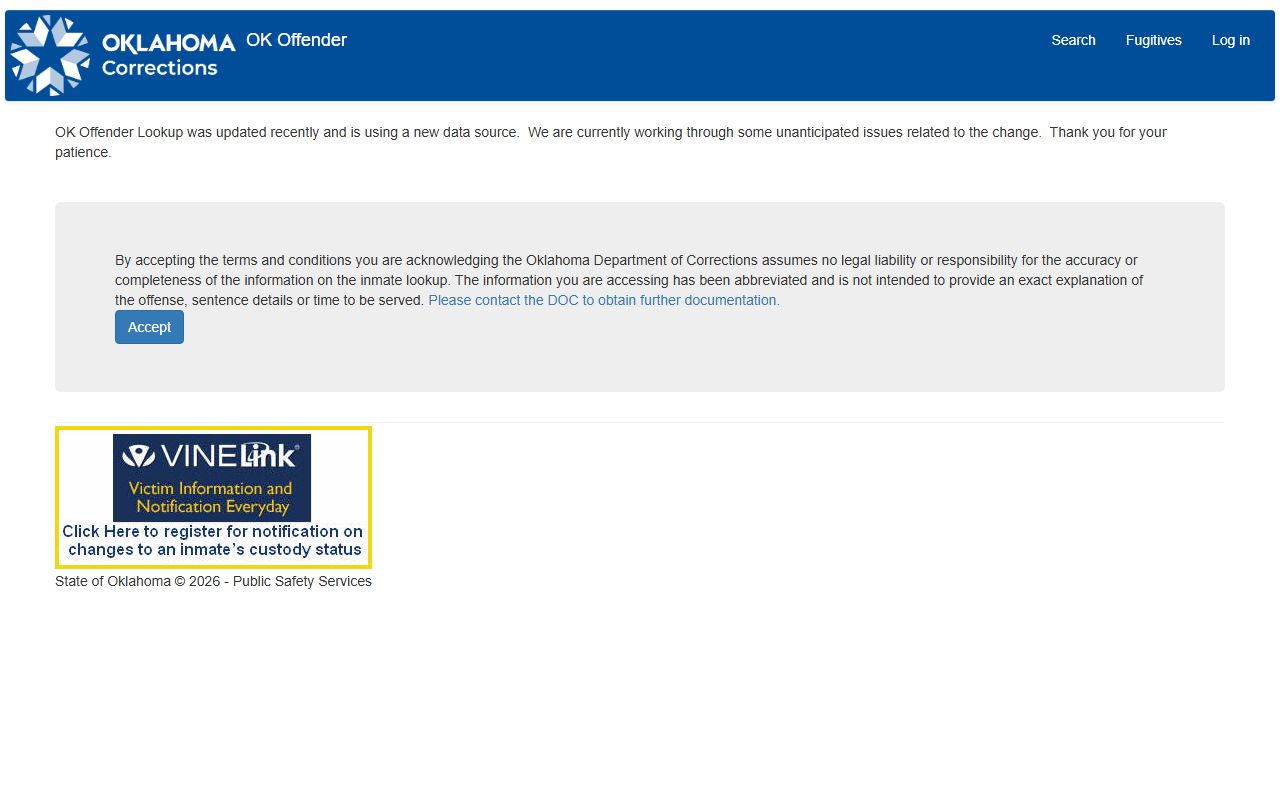
The DOC warns that its information is abbreviated and is not an exact explanation of the offense, the sentence detail, or the time to be served. Anyone who needs precise figures should contact the DOC for further documentation. For a person who has not been sentenced or transferred, the county jail remains the place to ask.
Oklahoma VINE Custody Notifications
VINE stands for Victim Information and Notification Everyday. It is a free statewide service that lets anyone check custody status and sign up for automatic alerts. When a registered inmate is released, transferred, or has a change in status, VINE can send a phone, text, or email notice. For someone worried about a release, this is a practical safety tool.
VINE is not a full booking file. It shows custody status, not the complete jail record, the charges by count, or court dates. Use it alongside a call to the Sheriff's Office rather than in place of one. Because VINE pulls from statewide data, a brand-new McIntosh County booking may not appear right away.
Note: VINE notifications depend on accurate data feeds, so confirm any release or transfer directly with the McIntosh County Sheriff's Office before you act on an alert.
What a McIntosh County Inmate Record Shows
Because the county does not publish a roster, there is no official sample inmate profile to copy. The fields below reflect the kind of arrest and booking information that Oklahoma open-records principles generally make available, not a confirmed McIntosh County screen. The county did not publish a roster field set, so treat the list as a guide to what staff may share rather than a fixed online format.
| Field | What It Shows |
|---|---|
| Name | The full name of the person booked into custody |
| Date of Birth | Used to tell apart people who share a name |
| Race and Sex | Basic descriptive identifiers kept in the booking record |
| Physical Description | Height, weight, and similar details when recorded |
| Arrest Facts | The cause of the arrest and the basic circumstances |
| Arresting Officer or Agency | Who made the arrest, such as the sheriff, a city police force, or the Highway Patrol |
Do not assume more than this. McIntosh County has not confirmed that mugshots, housing pods, bond amounts by charge, or court dates appear in any public inmate listing. The full charge detail and case outcome live in the court file, not the jail record. A closer look at the charges sits in the McIntosh County arrest records and charges.
The McIntosh County Jail Booking Process
Booking is the process that turns an arrest into a jail record. It follows a familiar order, even though the exact timing varies with the case and the workload. An arrest can come from the county sheriff, a city police force, the Highway Patrol, or a tribal or federal partner. The person is then transported to the county jail or another suitable detention facility for intake.
At intake, staff record the booking, inventory personal property, and run medical and security screening. Fingerprints and a photograph follow. The charge or hold is entered, and the case moves toward a first appearance and a bond decision in court. After that, the person is released, held, or transferred, depending on the charge and the judge's order.
For a current status, the Sheriff's Office is the source. Staff can say whether a person is still in the McIntosh County jail, whether a bond has been set, and whether they have been moved to another agency.
Note: Booking timing varies, so a person arrested late at night may not appear in any system until jail staff finish intake the next day.
Calling Dispatch After Hours
Arrests do not keep office hours. When the front desk is closed, county dispatch at 918-689-2526 is the line that stays staffed. Dispatch can route a custody question, confirm a recent booking, and point you to the right person in the morning. Keep the call short and have the name and date of birth ready.
Dispatch handles emergencies first. If your question is not urgent, calling back during business hours often gets a fuller answer from jail staff who can pull the booking record.
McIntosh County Jail Visitation and Mail
McIntosh County does not publish detailed visitation, mail, phone, or commissary rules on its official pages. That means the safe move is to confirm each rule with the Sheriff's Office before you visit, write, or send anything. The table pairs each common topic with what the county has published and the practical step to take.
| Topic | Official Detail Located | Practical Instruction |
|---|---|---|
| In-person visitation | Not published | Call 918-689-4357 before visiting |
| Video visitation | Not published | Ask staff whether video visits are offered and which vendor is used |
| Mail format | Not published | Confirm the inmate name, booking number, and address format before sending mail |
| Commissary and money | Not published | Ask jail staff for approved deposit methods |
| Phone calls | Not published | Ask booking staff about the phone provider and new-inmate access timing |
| Attorney visitation | Not published | Attorneys should call the jail or court to arrange professional visits |
| Children, dress code, ID | Not published | Confirm visitor ID, age, approval, and dress rules before arrival |
County jails commonly restrict cash, contraband, weapons, and revealing clothing, but the official McIntosh County rule list was not located. When in doubt, ask first rather than risk a wasted trip.
Money and Commissary at the McIntosh County Jail
Inmates often rely on a commissary account for snacks, hygiene items, and phone time. McIntosh County does not publish its commissary vendor, deposit limits, or fee schedule on the county pages reviewed. Rather than guess at a provider, ask the jail directly how money can be added to an account and which methods are approved.
Important: Do not send money through a third-party deposit site unless the McIntosh County jail confirms it is the approved method, since unverified services can lose funds.
Arrest Records and Open Records in McIntosh County
A jail booking is also an arrest record, and Oklahoma law leans toward openness. The Open Records Act, at 51 O.S. 24A.1 through 24A.20, treats records of public bodies as open unless another law makes them confidential. Section 24A.8 speaks directly to law-enforcement records, and the arrest and incident information agencies must release when they keep it. That is why basic arrest facts are generally available even without a public roster.
Open access has limits. Juvenile records are largely confidential, and personal identifiers such as Social Security numbers are withheld. An ongoing investigation can keep certain detail private. For everyday custody questions, though, the Sheriff's Office can confirm a booking under these open-records principles.
Note: An open investigation can keep some McIntosh County arrest detail private even when the basic booking facts are otherwise public under state law.
McIntosh County Warrants, Holds, and Federal Custody
Some people in the county jail are held on a warrant or a hold rather than a fresh arrest. A bench warrant, a probation warrant, or an out-of-county hold can keep a person in custody until a court acts. The Sheriff serves District Court warrants, and a paid ODCR tool can flag an outstanding warrant on a public case. The steps to confirm and clear one sit in the McIntosh County warrant records.
Federal custody is a separate track. McIntosh County lies in the U.S. District Court for the Eastern District of Oklahoma, which sits in Muskogee, not Eufaula. Serious cases, including many Indian Country matters after the McGirt decision, can land a person in federal custody handled by the U.S. Marshals. You can view the federal court's Muskogee Eastern District location page for the building and contact detail.
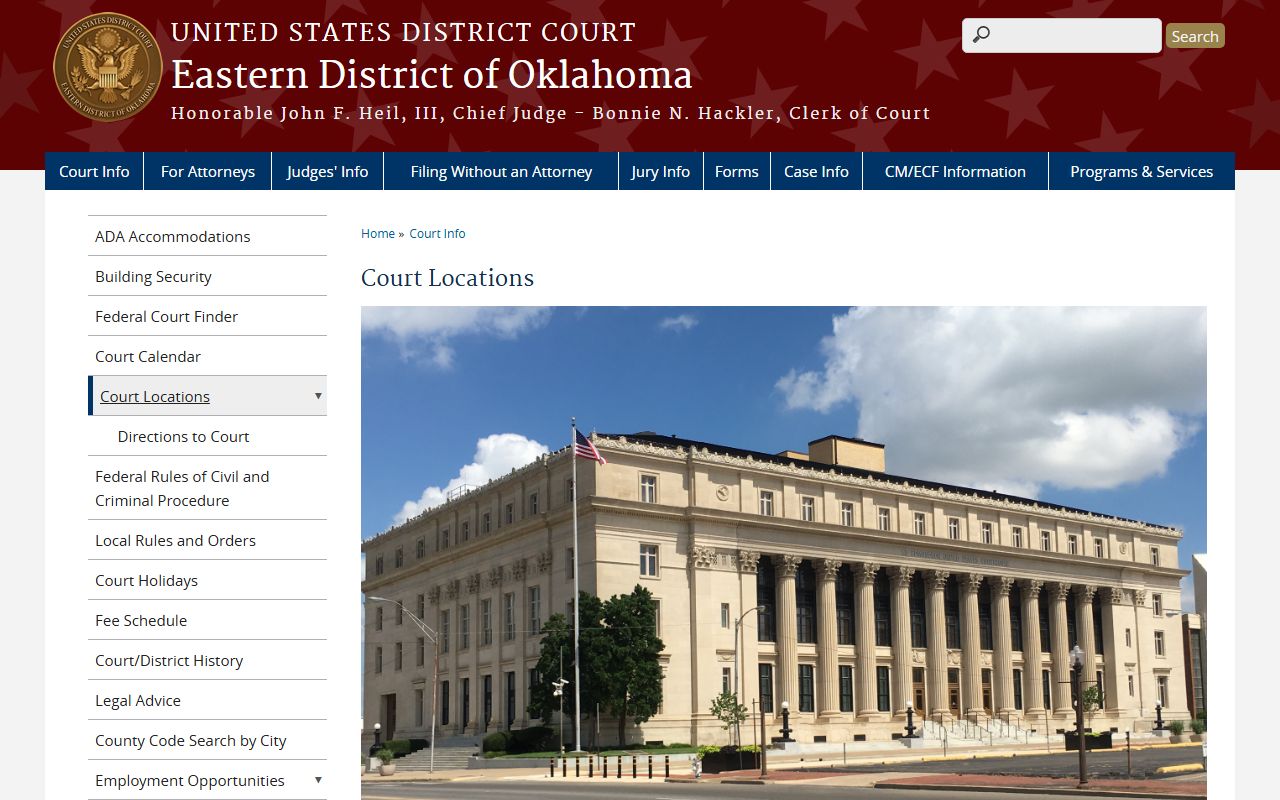
Federal inmates are not in the county jail and not in the state DOC system. They are tracked through federal channels instead. When a McIntosh County resident is named in a federal case, the custody question goes to the federal court and the Marshals in Muskogee.