
How to Search McIntosh County Court Records
Most McIntosh County court records start with one tool. That tool is On Demand Court Records, known as ODCR, at www1.odcr.com. McIntosh County links to it from the Court Clerk page. ODCR serves participating Oklahoma district courts, and McIntosh County is one of them. The portal lets you search by party name, case number, case type, and date. Results open as a docket. A docket lists the case events in order. The free side of ODCR is enough for most lookups, and the dropdown carries McIntosh County under the court value 046-.
Gather a few details first. A full name helps, and the format is Last, First. A case number narrows a McIntosh County search faster than a name. If you have neither, a case type plus a date range still works.
- Open the ODCR portal at www1.odcr.com.
- Choose Oklahoma District Courts, then pick McIntosh from the court list (court value 046-).
- Type a party name as Last, First, or switch to a full case number.
- Add a case type or a filed-date range if you know them.
- Click Search for cases, then open the matching docket to read the case events.
ODCR keeps its basic search free and charges for extra tools, and the portal breaks down each tier on its pricing page. The free tier covers unlimited name and case-number searches across McIntosh County court records, plus filed-date range searches and full docket text.
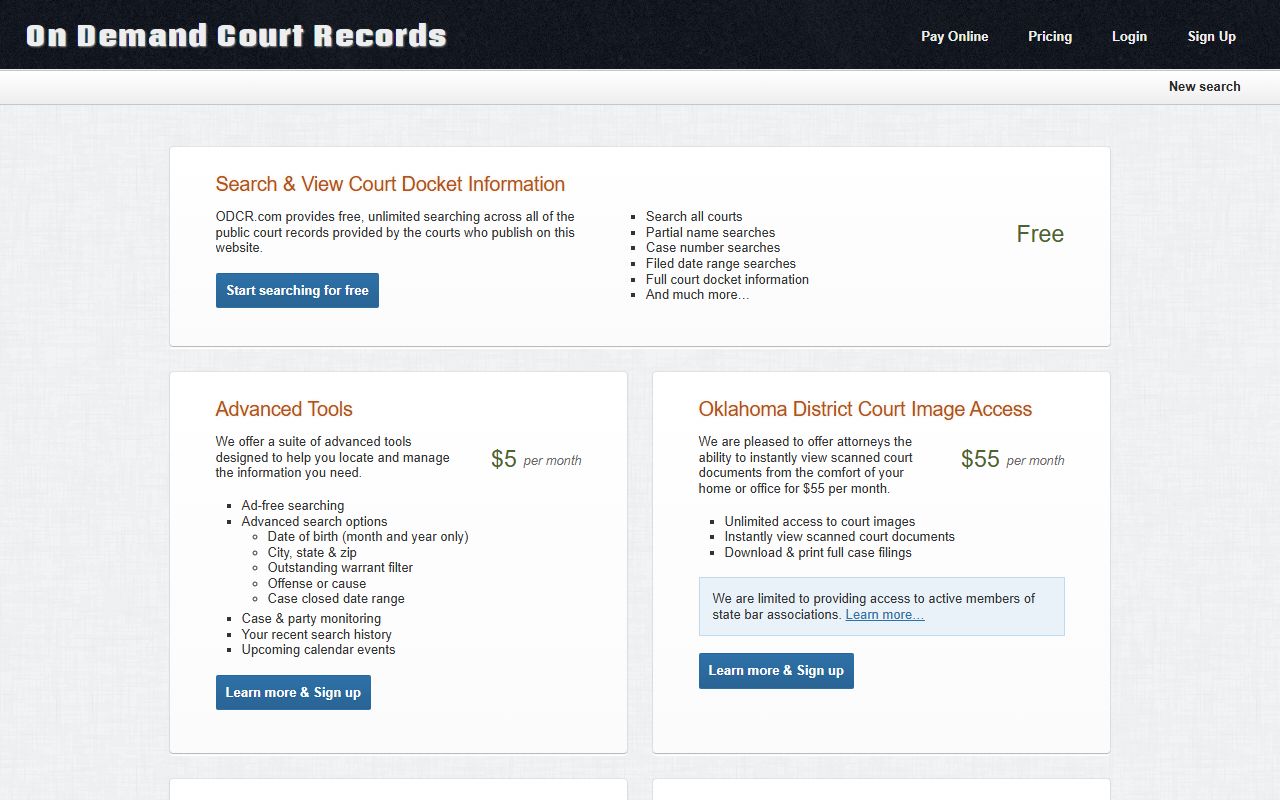
Paid plans run about five dollars a month and add a date-of-birth filter, an outstanding warrant filter, offense detail, case monitoring, and a search history. A higher image-access plan lets active bar members view and download scanned documents. For a quick McIntosh County court records search, the free tier does the job.
McIntosh County Court Records Search Fields
The ODCR form holds several fields. None of them is strictly required, yet the portal will reject a search that gives too little to work with. Pick the court first. Then add a name or a case number. The table below lists each field on the McIntosh County court records search form, what type it is, and how to fill it.
| Field Label | Type | Required | Notes / Format |
|---|---|---|---|
| Court group | Dropdown | No | All Courts, Oklahoma District Courts, or Tribal Courts |
| Court | Dropdown | Recommended | Select McIntosh; court value is 046- |
| Party name | Text | Depends | Format is Last, First |
| Party type | Dropdown | No | Plaintiffs & Defendants, or All Parties |
| Type of case | Dropdown | No | Felony, misdemeanor, traffic, probate, family, small claims, and more |
| Case number prefix | Dropdown | Depends | Common prefixes: CF, CM, CJ, FD, PB, PR, SC, TR, PO, ML, WL, YO |
| Case year | Dropdown | Depends | Two-digit year, 00 through 99 |
| Case number | Text | Depends | Numeric sequence after the prefix and year |
| Filed date range | Date | No | Start date through end date |
| Activity date | Date | No | A single date |
Leave a field blank when you do not need it. A blank field widens the search. If ODCR returns a message that not enough information was provided, add a name or a case number and run the McIntosh County search again.
ODCR and OSCN: Two Search Paths
Oklahoma runs two public docket systems. ODCR is one. The Oklahoma State Courts Network, or OSCN, is the other, at oscn.net/dockets. OSCN is the judiciary's own site. It offers a docket search, a non-OSCN county search, an available-records page, and a help section. McIntosh County District Court appears in the OSCN court list. ODCR tends to be the smoother path for McIntosh County court records, while OSCN gives a statewide view across many counties.
Both sites pull from the same McIntosh County case data, so a record found on one usually shows on the other. The wording and the layout differ. Use whichever opens the case faster. When the two disagree, the official file wins.
That rule is not a guess. The Oklahoma Court of Criminal Appeals spells it out in Rule 2.6, which treats the online case search as a public convenience and says the court's case-management record controls when the online data differs.
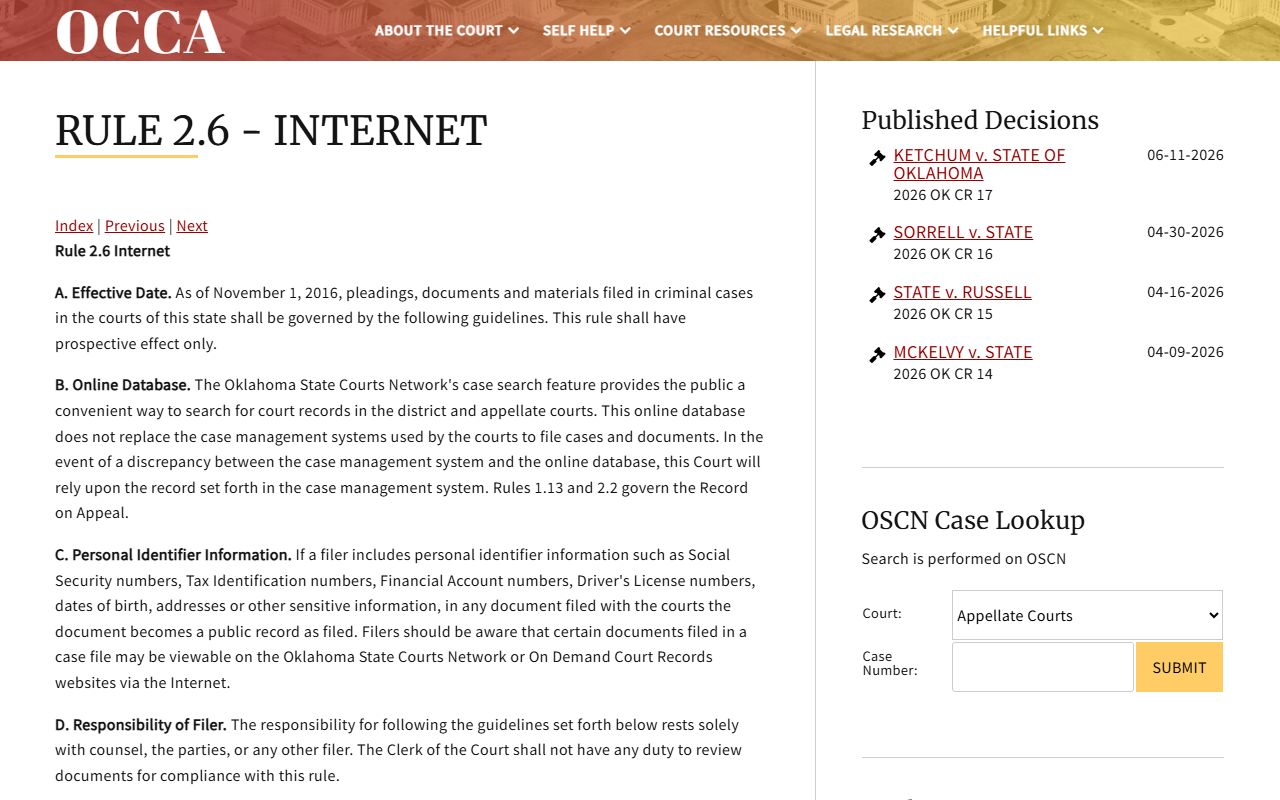
For most readers this matters only when a record looks wrong. A typo, a missing entry, or a stale date can appear in any online index. When the stakes are high, confirm the detail with the McIntosh County Court Clerk before you rely on it.
Note: Online dockets are a convenience copy, so a certified copy from the Court Clerk is what courts, agencies, and most legal proceedings will accept as proof.
Types of McIntosh County Court Records
The McIntosh County District Court hears a wide mix of cases. The McIntosh County Court Clerk files and keeps the records for each one. Civil and criminal cases sit side by side with family, probate, and traffic matters. Each category uses its own case-number prefix, which is how the search form sorts them.
These are the main record types you can search for McIntosh County:
- Civil records, including suits over money, judgments, liens, and small claims under the threshold amount.
- Criminal records, covering felony and misdemeanor cases, charges, bonds, and dispositions.
- Family and domestic records, such as divorce, paternity, custody, and support.
- Probate records, including estates, wills, guardianships, and conservatorships filed in District Court.
- Traffic records for citations written by the Highway Patrol and the county sheriff.
- Protective orders and marriage-license filings handled by the Court Clerk.
Juvenile and youthful-offender matters appear in the case-type list, but Oklahoma law keeps most of them confidential. Land deeds, plats, and tax liens are not McIntosh County District Court records at all. Those belong to the County Clerk.
What McIntosh County Court Records Show
Open a McIntosh County court record and you see a structured file. The header carries the case number, the court, and the case type. Below it sit the parties, the judge, and a running list of events. Criminal and traffic cases add charges, counts, bonds, and a disposition. The table below maps the common fields to what each one tells you.
| Field | What It Shows |
|---|---|
| Case Number | The unique ID built from a prefix, year, and sequence |
| Filing Date | The date the case opened with the Court Clerk |
| Parties | Names and roles, such as plaintiff, defendant, or petitioner |
| Charges or Counts | The offense, statute, and count number in criminal and traffic cases |
| Docket Events | Hearings, motions, orders, and filings listed in date order |
| Bond | The release amount or condition, when set |
| Disposition | The current or final outcome of a count or case |
| Costs and Fines | Court costs, fines, and payment status |
The case number itself carries meaning. Oklahoma builds it from a case-type prefix, a year, and a sequential number, so a file may read CJ-2020-1 or CM-2017-100. In McIntosh County the prefix tells you the kind of case at a glance. CF marks a felony. CM marks a misdemeanor. CJ is civil, FD is family, PB or PR is probate, SC is small claims, and TR is traffic. PO covers protective orders, ML covers marriage licenses, and YO marks a youthful offender.
Public Access to McIntosh County Court Records
Oklahoma law leans toward openness. The Open Records Act, found at 51 O.S. 24A.1 through 24A.20, says records of public bodies are open unless another law makes them confidential. Court files fall under that rule. So do most of the dockets you find on ODCR and OSCN. Anyone can look, and you do not need to give a reason.
Section 24A.5 of the same act sets the basic right to inspect and copy records during business hours, subject to the listed exceptions. Section 24A.8 addresses law-enforcement records and the arrest and incident information agencies must release when they keep it. You can read a McIntosh County court record for free online. Copies cost money. Certified copies cost a little more, because the McIntosh County clerk authenticates them.
Note: Open access does not erase the exceptions, so a sealed, juvenile, or adoption file can stay closed even when the rest of the docket is public.
Sealed and Confidential McIntosh County Records
Some files never reach the public McIntosh County docket. Juvenile cases are generally confidential. Adoption records are closed. Mental-health proceedings are sensitive, and most details stay private. Sealed and expunged cases drop out of public search by court order. Personal identifiers such as Social Security numbers, financial account numbers, and minor names are redacted across the board.
Expungement is the legal path to seal an eligible record. Oklahoma sets the categories and the steps in 22 O.S. 18 and 22 O.S. 19. An eligible person files a petition in the McIntosh County District Court, gives notice to the agencies that hold the record, and appears for a hearing if the judge orders one. If granted, the order tells the courts, law enforcement, and the OSBI to seal public access. Sealing does not destroy every government copy, and some agencies may keep a restricted version for authorized use.
Requesting Court Records in Person
Not every file sits online. Older cases, undigitized images, and certified copies often mean a trip to the counter or a call. The McIntosh County Court Clerk keeps the permanent District Court records in Eufaula. Staff can pull a McIntosh County court file, print copies, and certify them for a fee. Phone and mail requests work too. Bring a case number if you have one, since it speeds the search.
McIntosh County Court Clerk
110 N First St (PO Box 426)
Eufaula, OK 74432
918-689-2282
Mon-Fri 8:00 a.m. to 4:00 p.m.
The Court Clerk is not the only channel, and the right office depends on the record. Land deeds, plats, judgments recorded against property, and tax liens belong to the County Clerk, not the District Court. City tickets and ordinance cases may run through a municipal court, so check the court named on the citation. State-sentenced inmates are tracked by the Oklahoma Department of Corrections, which is separate from any court file. For day-to-day case data, ODCR and OSCN cover most of what the public needs, and the chronological McIntosh County court dockets show how each case moved through the system.
Note: The old courthouse burned in July 1925 and many records were lost, so some pre-fire McIntosh County court records may be incomplete or held only in archived form.