
What Is a Court Docket in McIntosh County
A docket is a chronological list of events in a case. Think of it as a timeline. The McIntosh County District Court adds a line each time something happens. A petition is filed. A hearing is set. A motion is ruled on. A judgment is entered. Each line carries a date, a short description, and sometimes the party who filed it. Read top to bottom and the whole history of the case appears in order.
A docket is not the same as the full case file. The docket names the documents and events. The file holds the actual documents themselves. In McIntosh County the same Court Clerk keeps both, and a docket entry often points to the underlying paper. McIntosh County dockets are the part most people search, because they are short, public, and usually free online.
How to Find McIntosh County Court Dockets Online
Two state systems carry the dockets. On Demand Court Records, or ODCR, sits at www1.odcr.com and lists McIntosh County District Court in its court menu. The Oklahoma State Courts Network, or OSCN, sits at oscn.net/dockets and offers a statewide docket search. Both pull from the same McIntosh County case data. Pick whichever opens the case faster. A name or a case number is the starting point for either one.
- Open ODCR at www1.odcr.com, or open OSCN at oscn.net/dockets.
- Choose Oklahoma District Courts, then select McIntosh from the court list.
- Enter a party name as Last, First, or type a full case number.
- Run the search and open the case to view its docket entries.
The result opens as a docket sheet. Scroll the entries from the oldest to the newest. Each line is a step in the case. If a McIntosh County search returns nothing, widen it with a case type or a date range, or check the spelling of the name.
McIntosh County Docket Search Fields
The ODCR search form is the same one used for all McIntosh County court records, and it doubles as the docket lookup. None of the fields is mandatory on its own, yet the portal needs at least a name or a case number to run. The table lists each field, its type, and how to fill it for a docket search.
| Field Label | Type | Required | Notes / Format |
|---|---|---|---|
| Court | Dropdown | Recommended | Select McIntosh; court value is 046- |
| Party name | Text | Depends | Format is Last, First |
| Party type | Dropdown | No | Plaintiffs & Defendants, or All Parties |
| Type of case | Dropdown | No | Felony, misdemeanor, traffic, probate, family, and more |
| Case number prefix | Dropdown | Depends | CF, CM, CJ, FD, PB, PR, SC, TR, PO, ML, WL, YO |
| Case year | Dropdown | Depends | Two-digit year, 00 through 99 |
| Case number | Text | Depends | Numeric sequence after the prefix and year |
| Filed date range | Date | No | Start date through end date |
| Activity date | Date | No | A single date of docket activity |
Use the date fields with care. The filed date and the activity date mean different things, and mixing them up is a common reason a docket search comes back empty.
Reading Events on a McIntosh County Docket
Each docket line marks one event. The text can be plain, like "Petition filed," or coded, like a short abbreviation for an order. A hearing date tells you when the parties are due in court. An activity date tells you when the clerk recorded the entry. A filed date tells you when a document first arrived. These three dates are not interchangeable. A reader who treats them as the same can misjudge where a case stands.
Watch the date types as you scroll. The filed date opens the case. Activity dates pile up as the case moves. Hearing dates point forward to scheduled appearances. Together they let you see both the past and the next step. A McIntosh County court docket reads as a story when you sort the dates correctly.
Warrant activity also shows on a McIntosh County docket. When a defendant misses a court date, the judge can issue a bench warrant, and that order lands on the docket as an event. The line may read failure to appear, with a date and sometimes a bond amount. A later entry shows when the warrant is recalled or returned. Sealed matters are the exception and may not appear at all.
Note: A hearing date on a McIntosh County docket can move, so confirm the current setting with the Court Clerk before relying on it for an appearance.
Sample McIntosh County Docket Entry
A docket result packs a lot into a small space. The header names the case, and each row below it logs an event. Knowing what each field carries makes the sheet easy to read. The table maps the fields you see on a McIntosh County docket to what each one tells you.
| Field | What It Shows |
|---|---|
| Case Number | The case ID built from a prefix, a year, and a sequence |
| Parties | Names and roles, such as plaintiff, defendant, or petitioner |
| Event Date | The date the filing, hearing, or order took place |
| Docket Code | A short abbreviation for the type of event |
| Docket Text | The plain-language description of the event |
| Party Filing | Who submitted the document or motion |
| Bond or Warrant | A release amount, or a warrant entry in criminal cases |
| Disposition | The current or final outcome of a count or case |
Not every field shows in every case. A simple civil matter may carry only filings and a judgment. A criminal case fills in charges, bonds, and warrant activity. The richer the case, the longer the docket.
Case Numbers on McIntosh County Dockets
The case number is the key to a McIntosh County docket. Oklahoma builds it from three parts. A prefix names the case type. A two-digit or four-digit year follows. A sequential number ends it. So a file can read CJ-2020-1 or CM-2017-100. Once you know the number, you can pull the docket straight from ODCR or OSCN without searching by name.
The prefix tells you the kind of case before you even open it. CF is a felony. CM is a misdemeanor. CJ is civil, and SC is small claims. FD covers family and divorce, while PB and PR mark probate. TR is traffic, PO is a protective order, ML is a marriage license, and YO marks a youthful offender. Spotting the prefix saves a step when you scan a list of McIntosh County court dockets.
Courts That Publish McIntosh County Dockets
Not every court posts its dockets in the same place. The McIntosh County District Court is the main one, and its cases run through ODCR and OSCN. That covers felony, misdemeanor, civil, family, probate, traffic, and protective-order matters. Municipal courts are different. City ordinance and city traffic cases may not appear in the District Court systems at all.
- McIntosh County District Court, searchable on ODCR and OSCN for most case types.
- Municipal courts, which handle city tickets and ordinance cases and may keep separate records.
- Federal court for the Eastern District of Oklahoma, searched through PACER rather than ODCR.
McIntosh County sits in the U.S. District Court for the Eastern District of Oklahoma, with the federal courthouse in Muskogee rather than Eufaula. The federal court explains its setup and access on its court information page. Federal dockets do not show up on ODCR or OSCN, because federal cases use the separate PACER and CM-ECF systems.
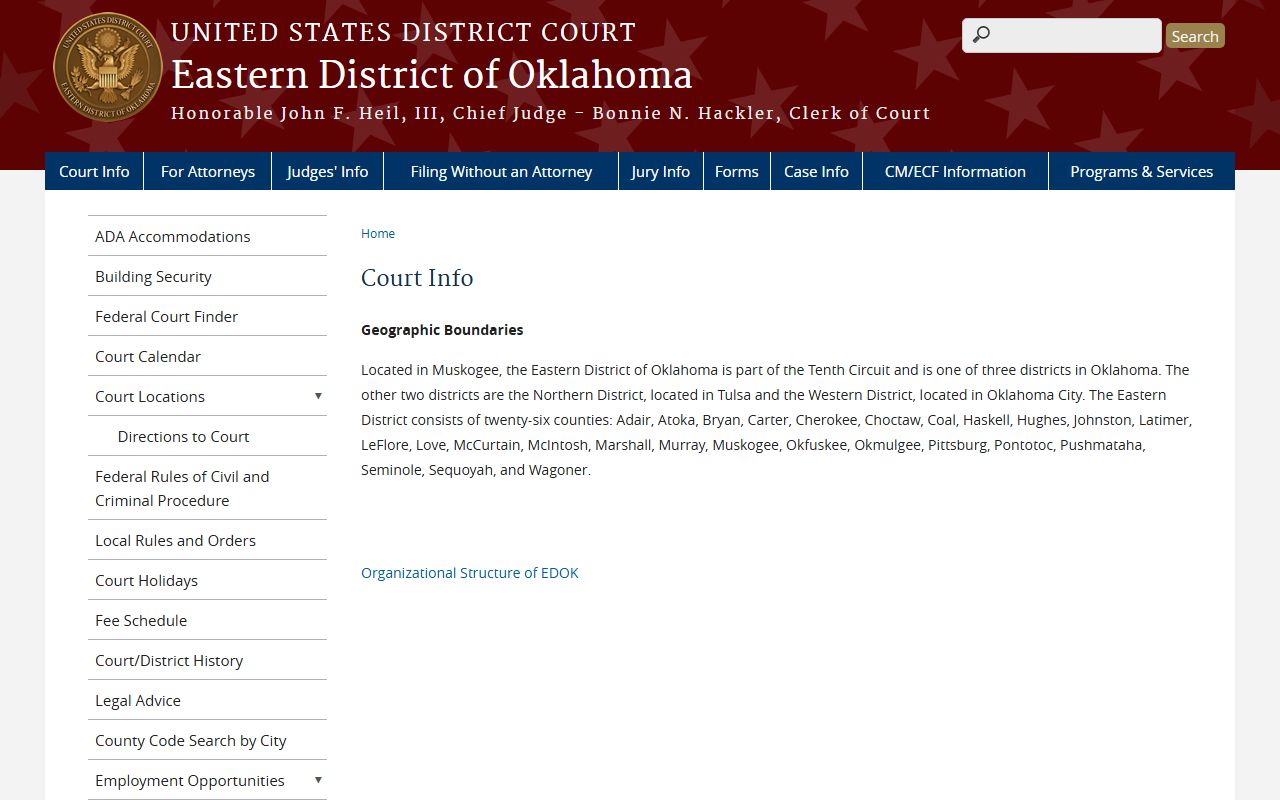
This split matters when you cannot find a case. A serious matter tied to McIntosh County may sit in the federal docket, not the state one. If a state search comes up empty for a known federal case, the docket likely lives in PACER instead.
Judges Behind McIntosh County Dockets
Behind every docket entry sits a judge. The McIntosh County District Court is staffed by District Judge Mike Hogan, Associate District Judge Brendon Bridges, and Special Judge Brian McLaughlin. They share the courthouse at 110 N First Street in Eufaula and the same court line, 918-689-2232. The judge assigned to a case signs its orders and sets its hearings, and the docket records each ruling under that case.
Local background fills in the picture. Judge Bridges was first elected in 2018 and won again unopposed in 2022. His practice before the bench spanned criminal defense, civil litigation, estate planning, probate, and appeals. That breadth mirrors the wide mix of cases a McIntosh County docket can hold, from a quiet probate file to a contested criminal trial.
Paying on a McIntosh County Court Docket
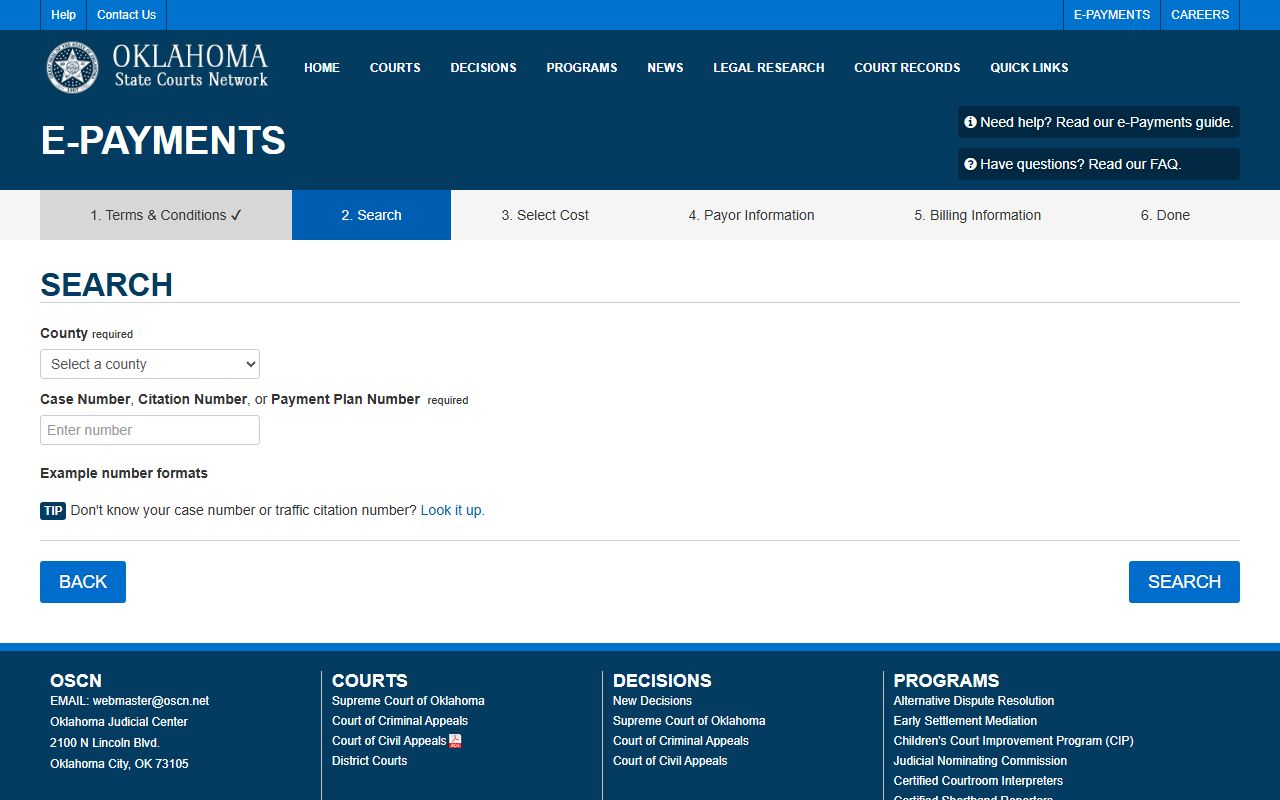
Some McIntosh County dockets end with money owed. Fines, court costs, and traffic fees attach to the case and show on the docket. Selected Oklahoma district courts accept payment online through the OSCN e-payments system at pay.oscn.net. The terms and the covered courts are spelled out on the OSCN e-payments page before you start. Confirm that McIntosh County and your case type are eligible, since not every court takes online payments.
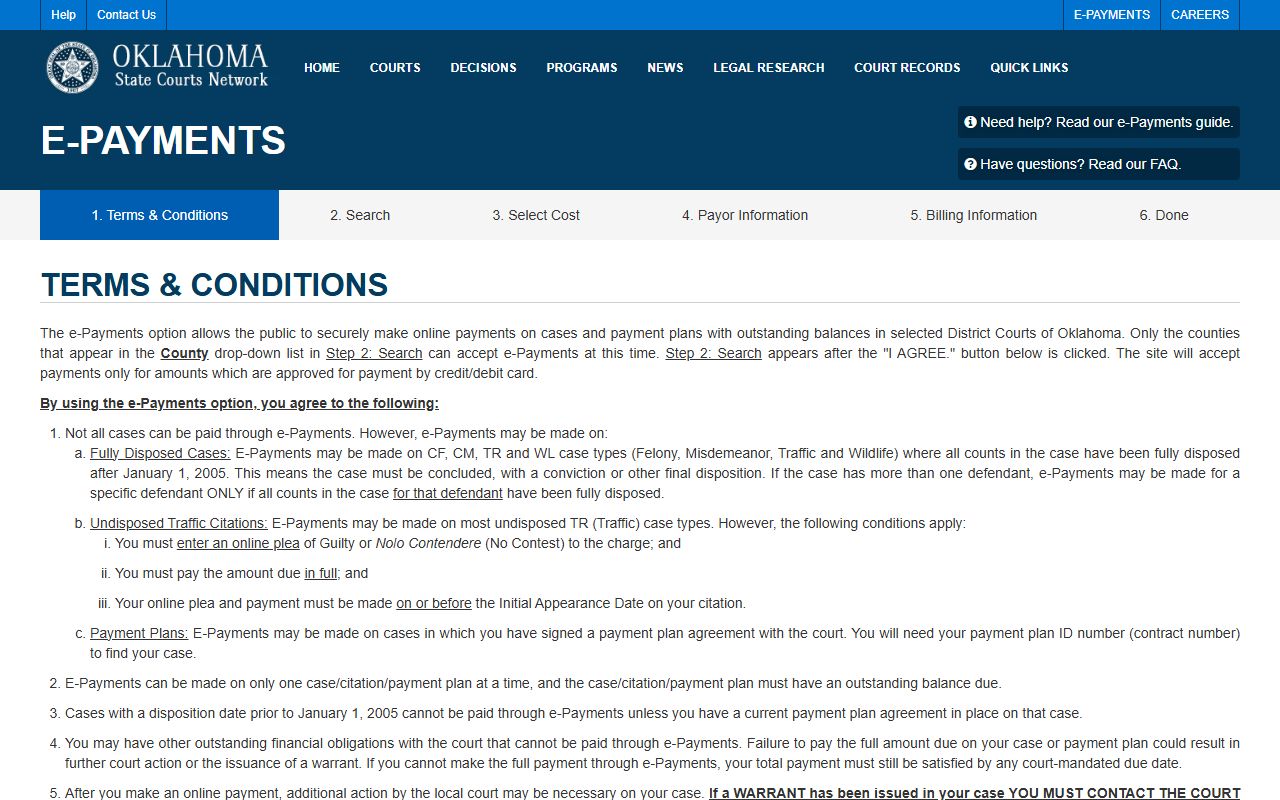
The payment side uses its own search. You can look up an amount by case number, by citation number, or by a payment-plan number. Sample formats look like CM-2017-100 for a case, PP-OK-2019-25 for a payment plan, and a short code such as M972124 for a citation. Municipal and sheriff citations may follow a different format, so match the number printed on your paperwork.
Paying on a McIntosh County docket can change it. A guilty or no-contest payment on a traffic citation may enter a disposition, and that outcome can reach the driver record. Read the terms before you pay, and ask the McIntosh County Court Clerk if you are unsure what a payment does to your case.
Note: Online payment systems cover only selected district courts, so confirm McIntosh County eligibility and your exact case or citation number before submitting any docket payment.
Docket vs. Full Case Record
The docket and the full case record are not the same thing, and the difference shapes how you use each one. A docket is the index of events. The full record is the stack of documents those events name. You read a docket to track progress. You pull the full McIntosh County case file to review the actual motions, orders, and exhibits. The comparison below sets the two side by side.
| Docket | Full Case Record | |
|---|---|---|
| What it is | A dated list of events | The complete documents and exhibits |
| Access | Usually online and free | May need a fee, an image plan, or a visit |
| Detail | Short summaries of each step | Full text of filings and orders |
| Best use | Track case progress and dates | Legal review and evidence |
| Where | ODCR and OSCN online | Court Clerk counter or paid image access |
Remember that the online docket is a convenience copy. The Oklahoma Court of Criminal Appeals says so in Rule 2.6, which treats the online search as a public convenience and says the court's case-management file controls when the two differ. For the full document set and how to request copies, the broader guide to McIntosh County court records covers the Court Clerk's process, and a criminal court record adds the charges, pleas, and sentence the docket only summarizes.