
About the McIntosh County Court Clerk
Lisa Rodebush is the McIntosh County Court Clerk. The office sits inside the McIntosh County Courthouse in downtown Eufaula. The Court Clerk is an elected county officer, and the role runs the day-to-day records work of the District Court. That work touches almost every case the court hears.
The county page sums up the job in one line. The office records, files, and keeps the permanent records of all proceedings of the District Court. In plain terms, when a case opens, moves, or closes, the Court Clerk writes it down and stores it. Staff also take in money the court orders and pass it along to the right fund.
McIntosh County Court Clerk
Clerk: Lisa Rodebush
110 N First St (PO Box 426)
Eufaula, OK 74432
918-689-2282
mcintoshclerk@oscn.net
Mon-Fri 8:00 a.m. to 4:00 p.m.
What the McIntosh County Court Clerk Does
The Court Clerk wears many hats. The office is the records hub for the District Court, but the duties reach past filing and copying. The clerk maintains an appearance docket for each case, which is the running list of events that a search later reads back to you. The office also handles licenses and orders that have nothing to do with a single lawsuit.
These are the core duties the McIntosh County Court Clerk carries out:
- Records, files, and keeps the permanent records for civil, criminal, probate, juvenile, domestic relations, and small claims cases.
- Maintains the appearance docket for every case filed in the District Court.
- Processes traffic citations written by the Oklahoma Highway Patrol and the McIntosh County Sheriff.
- Issues marriage licenses and private process server licenses, and registers bail bondsman licenses.
- Files victim protective orders and keeps the court reporter transcripts filed in proceedings.
- Issues jury summonses, keeps jury-service records, and collects fines, court costs, and fees.
That last duty matters to anyone paying a case. The Court Clerk collects and distributes the licenses, fines, court costs, and fees a case generates, then sends each share to the proper account. So a fine paid at the counter is logged against the case and split among the funds the law sets.
Court Clerk vs County Clerk in McIntosh County
McIntosh County has two clerks, and people mix them up all the time. The names sound alike. The records do not overlap. Sending a request to the wrong office is the most common reason a search stalls.
The Court Clerk handles court matters. Think case files, dockets, charges, judgments in a lawsuit, marriage licenses, and protective orders. The County Clerk handles land and county business. Think deeds, plats, mortgages, liens recorded against property, tax warrants, and county board minutes. A judgment entered in a District Court case lives with the Court Clerk, while a lien recorded against a parcel of land lives with the County Clerk. When your need is a deed, a plat, or a recorded lien, start with the McIntosh County Clerk land records instead.
Note: If you are unsure which office holds a record, the test is simple, since the Court Clerk keeps case files and the County Clerk keeps land and county records.
McIntosh County Court Clerk Forms
The Court Clerk does not host its own library of fill-in court forms. Instead, the office forms page points users to OSCN for court-form needs. OSCN is the Oklahoma State Courts Network, the judiciary's own site, and it carries the approved statewide forms that District Courts use.
You can see the office's own direction on its Court Clerk forms page, which sends filers to the state forms rather than a local packet.
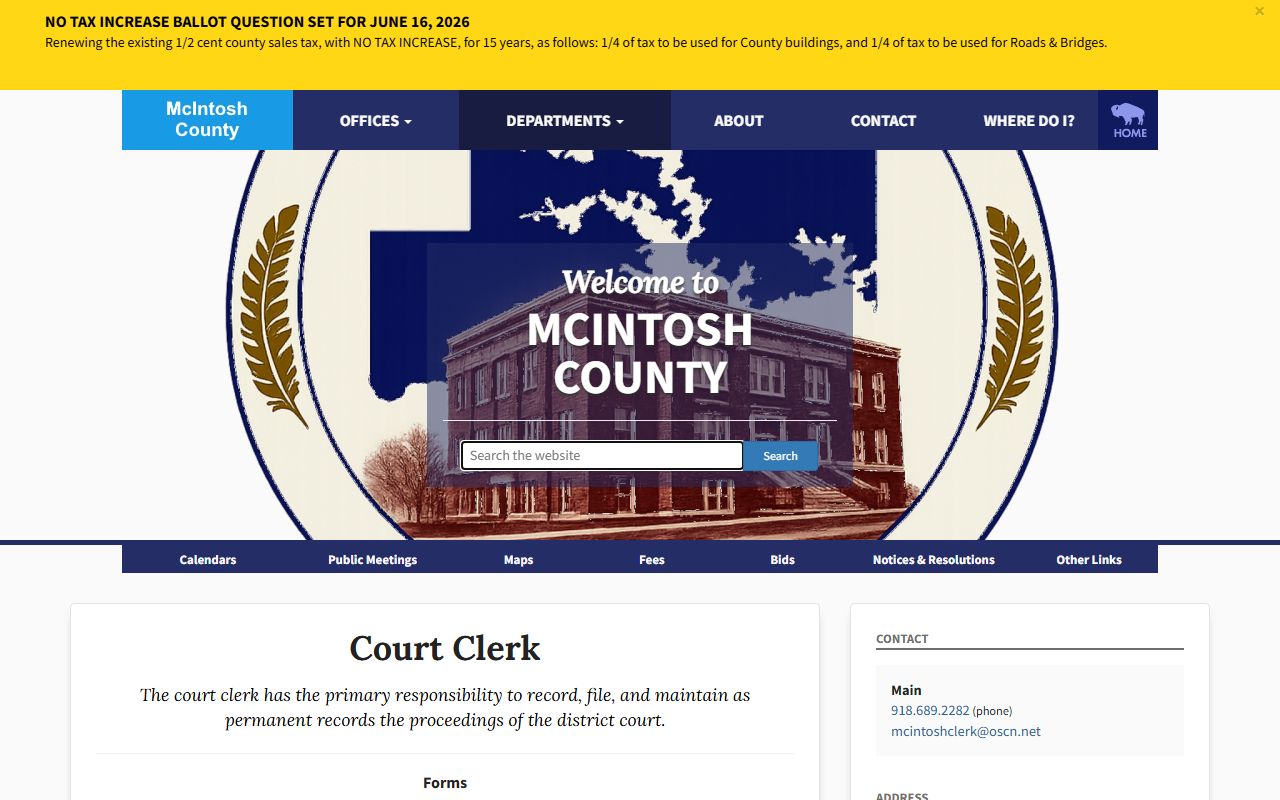
That setup keeps the local forms current with state rules. For a case search rather than a blank form, the Court Clerk page links instead to ODCR and OSCN, the two public docket systems that carry McIntosh County District Court cases.
How to Request a Certified Copy
A certified copy is a clerk-authenticated copy that courts and agencies accept as official proof. People need one for many reasons. A name change, a probate filing, an appeal, or a record for an out-of-state matter often calls for the certified version, not a free printout from an online docket.
Here is how to get a certified copy from the McIntosh County Court Clerk:
- Find the case number first. Look it up on ODCR or OSCN by party name, or call the office to confirm the file you need.
- Decide what you want copied. A full case file, a single order, or a marriage license each carries its own page count.
- Contact the Court Clerk by phone, by mail to PO Box 426, or at the counter at 110 N First St in Eufaula.
- Pay the copy and certification fees the office quotes for your request.
- Pick up the certified copy in person, or have it mailed back to you.
Mail requests work well for people out of the area. Include the case number, the parties, the document you want, and a daytime phone number. A short note that you want the copy certified tells staff to add the clerk's authentication.
Records Request Details to Provide
A clean request moves faster. The more the Court Clerk knows about the file, the less time staff spend hunting for it. The fields below cover what to include when you ask for McIntosh County court records, whether you call, write, or visit.
| Field | Required | Notes |
|---|---|---|
| Case Number | Helpful | Format is a prefix, year, and sequence, such as CF-2020-1 |
| Party Names | Yes | Defendant or both parties speeds a name-based search |
| Document Type | Yes | Full file, a single order, judgment, or marriage license |
| Certified or Plain | Yes | Say if you need the clerk's certification for legal use |
| Number of Copies | Yes | Each copy and certification carries its own fee |
| Contact and Return Method | Yes | Daytime phone, plus pickup or a mailing address |
Bring a case number when you can. A case number narrows a search faster than a name, since common names can return many McIntosh County files. If you only have a name and a rough date, staff can still search, but it takes longer.
McIntosh County Court Clerk Fees
Court fees come in two kinds. Some are set statewide and rarely change. Others, like District Court filing and copy charges, are confirmed at the counter rather than posted online. The marriage license is the clearest published fee tied to the Court Clerk, and Oklahoma law backs it.
| Item | Amount |
|---|---|
| Marriage license | $50 |
| Marriage license with qualified premarital counseling | $5 |
| Certified copy | Confirm with Court Clerk |
| Plain copy per page | Confirm with Court Clerk |
| Civil and criminal filing fees | Confirm with Court Clerk |
The marriage license runs $50, or $5 when the couple completes qualified premarital counseling. Oklahoma sets that structure in 43 O.S. 5 and 5.1 for the application and the counseling discount, and in 28 O.S. 31 for the court clerk fee. The license is valid in any Oklahoma county and returns to the issuing clerk after the ceremony.
Note: McIntosh County does not publish its District Court filing and copy fees online, so confirm the current amount with the Court Clerk before you mail a request or payment.
Public Access and the Open Records Act
Oklahoma law leans toward open records. The Open Records Act sits at 51 O.S. 24A.1 through 24A.20. It says the records of public bodies are open for inspection and copying unless another law makes them confidential. Court files fall under that rule, and so do most of the dockets the Court Clerk maintains.
Two sections fill in the detail. Section 24A.5 sets the basic right to inspect and copy records during business hours, subject to the listed exceptions. Section 24A.8 covers law-enforcement records and the arrest and incident information agencies must release when they keep it. You do not have to give a reason to read a McIntosh County court record. The open rule has limits, though. A sealed, juvenile, adoption, or mental-health file can stay closed even when the rest of the docket is public.
Searching and Paying McIntosh County Cases Online
Most case lookups start online before they ever reach the Court Clerk counter. The office links to two public docket systems. ODCR, On Demand Court Records, carries McIntosh County District Court cases and runs a free basic search by name, case number, case type, and date. OSCN, the state judiciary's site, offers a second path with a statewide view.
Many case types can also be paid online. OSCN runs an e-payments page where eligible District Court cases are paid by case number, citation number, or payment plan number. ODCR offers its own pay-online tool for eligible disposed traffic, felony, misdemeanor, and wildlife cases, plus pleas and payments on some undisposed traffic citations. Read the eligibility notes first, since a guilty or no-contest payment can create a court disposition.
When a record is too old to appear online, or you need a certified copy, the counter, phone, and mail channels take over. The Court Clerk pulls the file, prints it, and certifies it for a fee. For a closer look at the chronological case history, the McIntosh County court dockets show how each case moved from filing to disposition.
Note: An online docket is a convenience copy, so a certified copy from the McIntosh County Court Clerk is what courts and agencies accept as official proof.
Older McIntosh County Court Records
Some files predate the digital era and some predate the current courthouse. The old courthouse burned in July 1925, and many county records were lost. The current courthouse was built in 1927. That fire shapes any search for older McIntosh County court, probate, and marriage records.
Records still exist from before the fire, but the set is uneven. If a pre-1925 file is missing from the local index, a researcher may need archived indexes, Oklahoma Historical Society material, or docket references to fill the gap. For anything recent, the Court Clerk and the online dockets cover the ground. For the oldest material, call the office first and ask what survives before you make the trip.